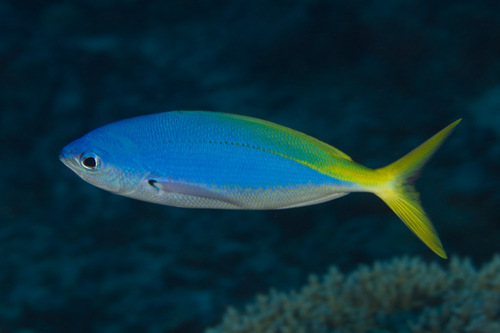
About Caesio teres Seale, 1906
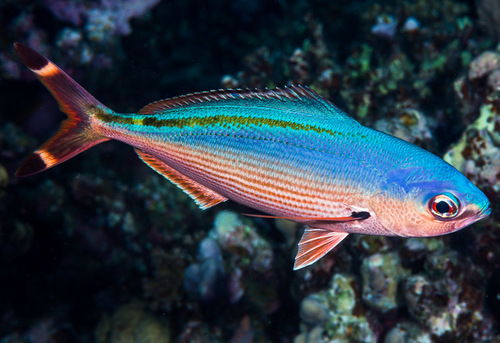
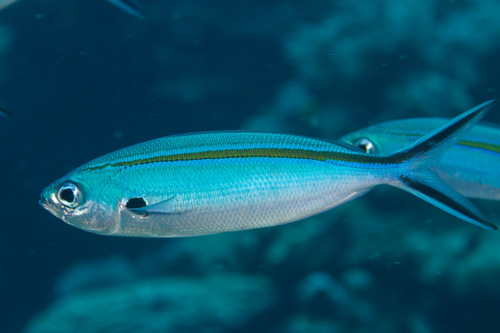
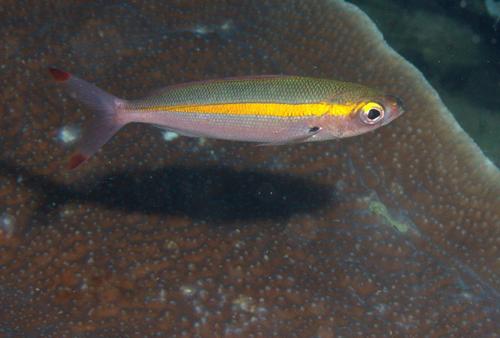
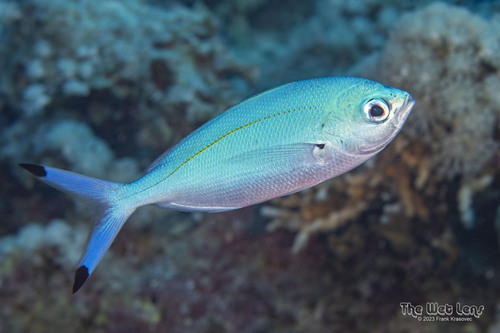
Caesio teres Seale, 1906 has a moderately deep, fusiform, laterally compressed body. Its dorsal fin has 10 spines and 14 to 16 soft rays, most often 15; the anal fin has 3 spines and 12 to 13 soft rays; the pectoral fins have 20 to 22 rays, most often 21. This species reaches a maximum total length of 40 cm (16 in), with a more typical maximum total length of 26.6 cm (10.5 in). The upper back and rear portion of the dorsal fin are bright yellow. The rest of the upper body is bright blue, and the ventral body is white. The pectoral fin is white with a black upper base, while the pelvic and anal fins are white. Caesio teres has a wide distribution across the tropical Indo-West Pacific. It occurs from the East African coast between Somalia and South Africa, east into the Pacific Ocean as far as the Line Islands and Tuamotu Islands, north to southern Japan, and south to the Great Barrier Reef. It is not found in the Red Sea or the Persian Gulf. In Australian waters, it occurs at Rowley Shoals in Western Australia, at Ashmore Reef in the Timor Sea, and from the northern Great Barrier Reef to Escape Reef, Queensland. It is also found at Christmas Island and the Cocos (Keeling) Islands. This species inhabits coral reefs at depths ranging from 5 to 60 m (16 to 197 ft).