About Caesia perpinguis (Hinds, 1844)
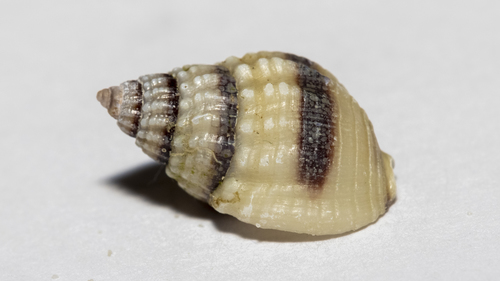
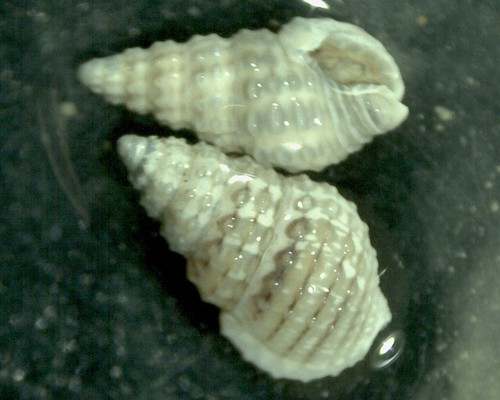
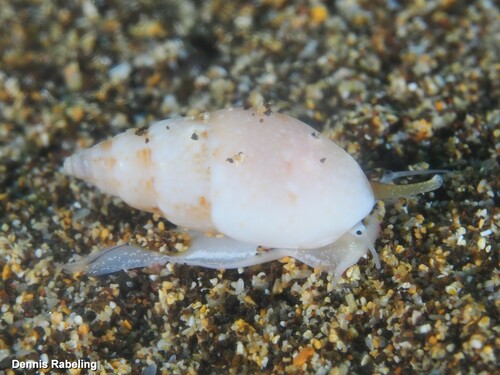
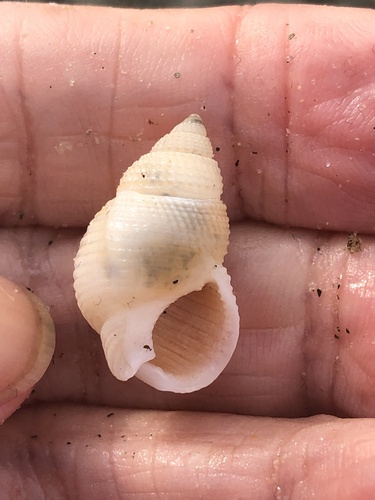
This species is currently known by the scientific name Caesia perpinguis (Hinds, 1844). One historic description of this shell, published under the name Nassa interstriata, notes that the shell has an ovate-acute shape and contains 5½ whorls. The whorls are rounded and cancellated. Longitudinal striae are nodulous, except towards the base of the body whorl. The shell surface is roughened by a tubercle on each longitudinal stria, located at every intersection with the revolving lines. There is a deep sulcus behind the aperture, and the two uppermost whorls are entire. The outer lip is striated on its inner surface. The spire is conical, and it is longer than the aperture. A color variant described as Nassa perpinguis var. bifasciata is a color form of Caesia perpinguis. This color variant is strikingly distinct from the typical form, and is considered to deserve a varietal name if color forms are to be named. It differs from the ordinary form by having two broad spiral bands of deep chestnut color, which stand in abrupt contrast to the shell's grayish-buff ground color. One band is located just below the suture, and the other sits around the shell's periphery. Occasionally, a fainter third band appears at the extreme base of the body whorl. The bands vary considerably in width, and no observed specimens have only a single band. This species has been found in Magdalena Bay on the western coast of Mexico, and also in the Persian Gulf.