About Caedicia simplex (Walker, 1869)
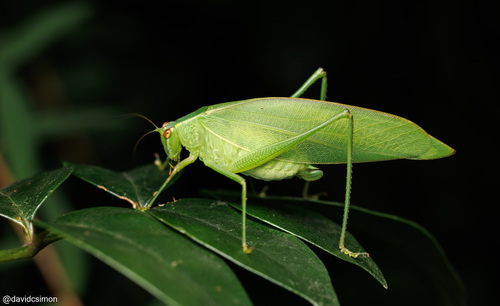
Members of the bush cricket/katydid family Tettigoniidae are distinguished from other ensiferan orthopterans by forewings that can be held away from the body, modified for both leaf mimicry and acoustic communication, as well as by the female's ovipositor. In general, katydids have antennae that are extremely long relative to their body size, a cylindrical or laterally compressed body, and three pairs of long, thin legs adapted for long-distance jumping. Among all katydids, Caedicia simplex is considered an unremarkable species in terms of appearance. Commonly called the common garden katydid, it strongly resembles a small leaf and has a grass-like green coloration; adult individuals measure approximately 4–6 cm in length. In the nymph stage, however, C. simplex may sometimes be a vibrant red-pink, and does not have the leaf-like appearance of adults. Caedicia simplex has a distinctly small, oval head with a velvety green texture and bright orange-red eyes. The velvety pronotum of the common garden katydid is distinctly keeled, marked with a yellow stripe, and has a notched anterior margin and a rounded posterior. Caedicia simplex is native to New Zealand and Australia, and its natural range is restricted to these two countries. Other katydid species in the family Tettigoniidae are found on all continents except Antarctica. In his original description and analysis of Caedicia simplex distribution across New Zealand, Walker noted that the species was abundant throughout the entire North Island, ranging as far south as Greymouth, New Zealand. Today, the species remains distributed across roughly the same regions in both the North and South Islands. Because the family Tettigoniidae has a very broad global distribution, the habitats of its species vary widely between countries. In New Zealand, C. simplex is extremely common in home gardens, which is how it earned its common name, and also in more heavily forested areas. The katydid usually stays close to vegetation like shrubs and other plants, which allows it to camouflage effectively and have a nearby source of food and nutrients. As a nocturnal species, it only moves around its vegetation habitat during the night; this behavior maximizes its safety and success when collecting food. The full life cycle of Caedicia simplex takes approximately one year to complete. Its mating season typically occurs during the rainy season in the New Zealand/Australia region. This katydid is polygamous, meaning individuals have more than one mate over their lifetime. Males start the mating process by rubbing their wings together to produce the characteristic 'katydid' sound that attracts females. Females can assess a male's fitness based on how loud his call is, and this assessment informs which male she chooses to mate with. Females always prefer to mate with males that produce larger spermatophores. During mating, the male deposits sperm into the female. After mating, the female uses her ovipositor to lay her eggs in the ground or in the stem of a nearby plant. A nymph, or juvenile katydid, hatches from the egg. Nymphs do not have the size, wings, or full green coloration of adults, and must go through multiple molts to reach maturity. Around two to three months after hatching, nymphs undergo their final molt, which results in the growth of wings and the development of their full adult size. Full adulthood occurs late in the katydid's one-year lifespan, so mating becomes a priority as soon as the final molt is complete. After mating in the autumn, adult katydids typically die as colder winter weather sets in, while their eggs remain dormant until spring, allowing the life cycle to repeat. The egg is the only life stage of this katydid that can survive winter; eggs remain in place where they were laid until warmer spring temperatures arrive.