About Cadlina laevis (Linnaeus, 1767)
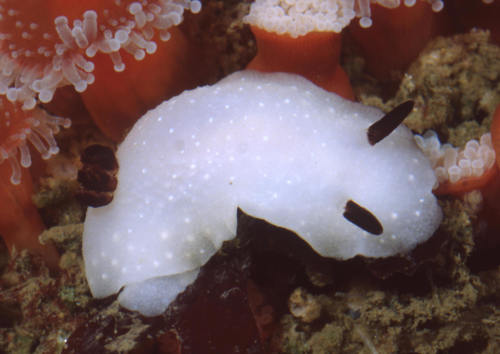
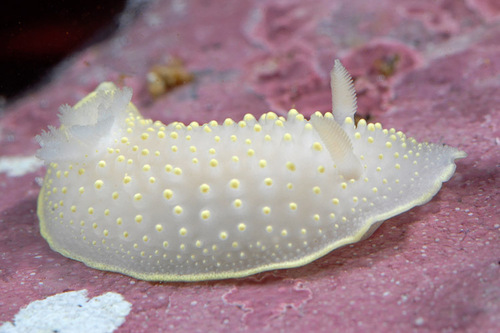
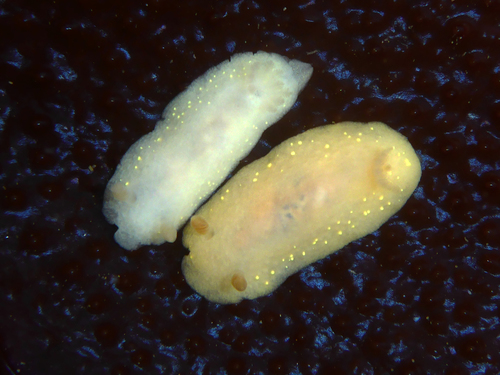
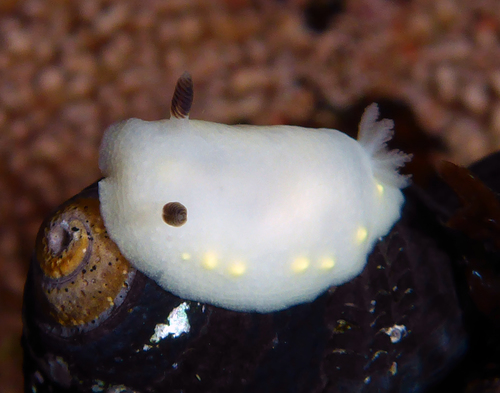
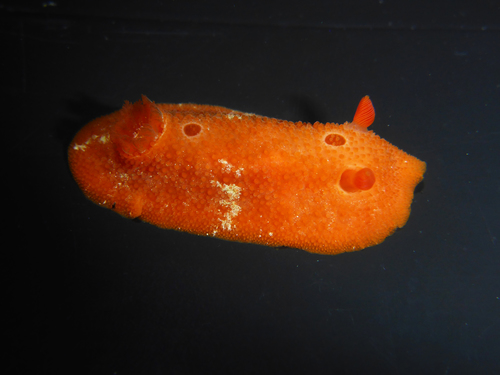
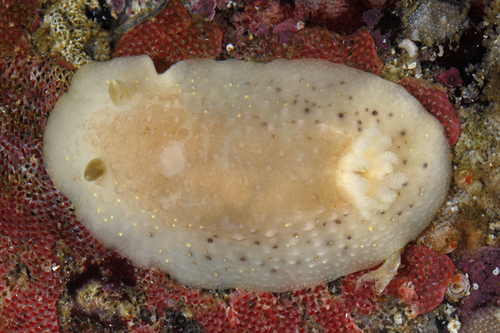
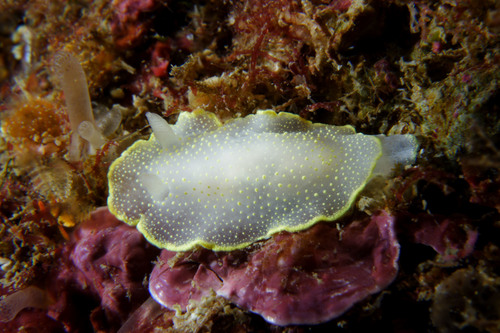
Cadlina laevis, commonly known as the white Atlantic cadlina, has a flattened, oval, white, semitransparent mantle. There are three distinct color forms of this species: one has bright yellow spots near the thin yellow margin on its back, one is solid milky white with no spots, and an intermediate form has milky yellow spots. These color forms do not typically co-occur: the yellow-spotted form lives in deeper water, while the unspotted milky white form lives in intertidal zones. Its short cephalic tentacles are comblike. The short, tripinnate gills located at the back of the body are cryptobranchiate, meaning all gills can retract together into a shared branchial pit. Observed body lengths of these sea slugs range between 25 mm and 32 mm, while the maximum recorded length is 17 mm. This species is found in widely separated dispersed populations on rocky bottoms, ranging from the low tide zone down to 800 m depth. Its distribution extends from the Arctic to the North Atlantic, including the Canadian Arctic Archipelago, Spitsbergen, Iceland, and Greenland. Along the North American coast, its range reaches as far south as Massachusetts. It also occurs along the European coast from Norway down to northern Spain. A report of a Cadlina with yellow markings near the Portuguese west coast may represent an unnamed separate Cadlina species. The minimum recorded depth for this species is 0 m, and the maximum recorded depth is 250 m. This nudibranch preys on encrusting slime sponges, such as Halisarca dujardini, or the deeper-water sponge Dysidea fragilis. It is reported to breed at the end of winter. The male reproductive penis of this species is covered with tiny chitinous hooks. Cadlina laevis reproduces via direct development. After approximately fifty days, the eggs hatch directly into small slugs, skipping the planktonic larval stage; the veliger phase develops entirely within the egg.