About Cadaba aphylla (Thunb.) Wild
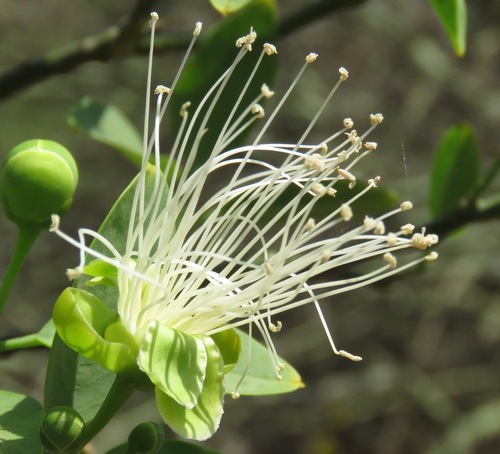
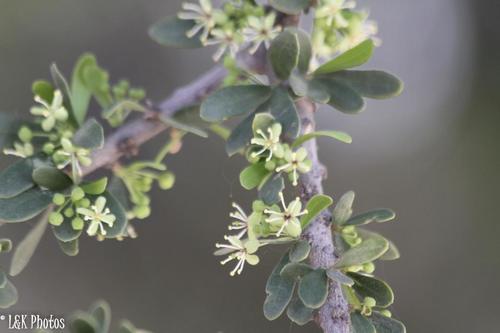
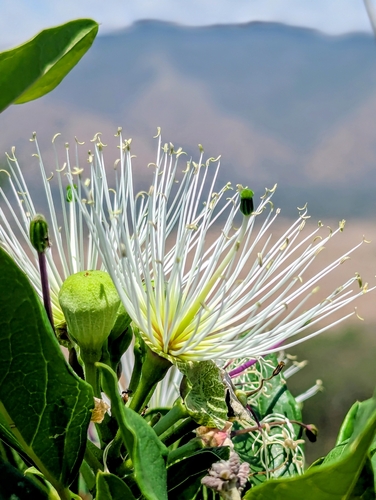
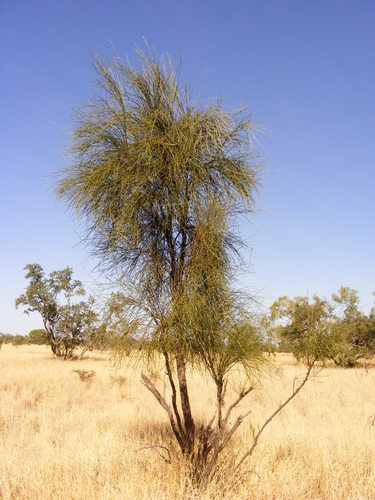
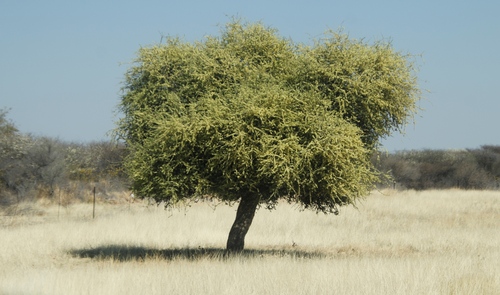
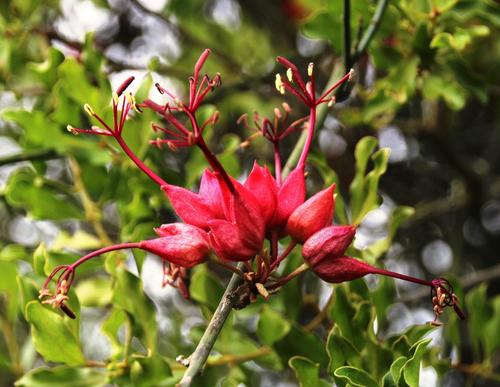
Cadaba aphylla (Thunb.) Wild grows as a straggly, perennial virgate much-branched shrub or small tree, dark green, often with a purple bloom, and usually leafless. It can reach a maximum height of 2 meters. Its branches are somewhat succulent and frequently tipped with spines. Leaves measuring around 10 × 2 mm only grow on seedlings and young branchlets. Mature plants have stiff, rather virgate, smooth branches, which are green or glaucous with subspinous apices and are glabrous; young branches bear subulate leaf scales up to 2 mm long. This plant produces deep-red flowers (rarely yellow), arranged in axillary clusters, with prominently exserted stamens, making it a colourful plant in summer. Flowers are arranged in short, corymbose axillary racemes, with a rachis 0.3–2.3 cm long that is glabrous or glandular-pubescent; bracts are subulate, around 1 mm long; pedicels are glabrous or glandular-pubescent and grow up to 1.3 cm long. It has 4 sepals, which are yellow or reddish-purple, measuring 1–1.7 × 0.7–1 cm; the lowest sepal is somewhat larger than the others, they are connate at the base into a very shallow receptacle around 1 mm in depth, broadly elliptic, obtuse at the apex, with capitate glandular hairs sparsely or densely scattered on both sides. This species produces no petals. The androgynophore is 2.5–3 mm long, glabrous, shallowly declinate, with a hooded nectary around 4 mm broad at its base. There are 8 stamens, with 1 cm long filaments and oblong anthers measuring 2.3 × 0.75 mm. The gynophore is around 1 cm long, glabrous or glandular-pubescent. The ovary is narrowly cylindric, glabrous or glandular-pubescent, holding numerous ovules on 2 placentas; the stigma is capitate and sessile. Fruits can grow up to 90 mm (or 8 × 0.4 cm) in length; they are cylindric, subtorulose, green when young, turning rusty brown when mature, and covered in sticky hairs, with glandular or minutely verrucose texture and hold many seeds. A sticky orange pulp covers the small black seeds; other descriptions note seeds are brown, around 0.3 cm in diameter, and subglobose. This species occurs in dry bushveld or semidesert environments, ranging from tropical Africa to Namibia, Zimbabwe, Botswana, and South Africa. At its southern range extent, it grows in clay-rich soils in the Little Karoo and Overberg regions, reaching as far south-west as the town of Montagu.