About Cacyreus marshalli Butler, 1897
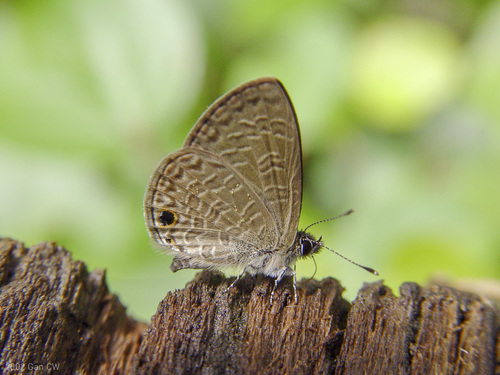
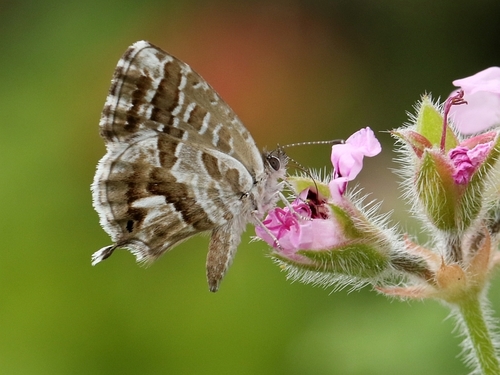
The adult geranium bronze butterfly (Cacyreus marshalli Butler, 1897) has a wingspan of 15–23 mm for males and 18–23 mm for females. Males and females have similar overall appearance. Their wings are brown or bronze, with a white border along the edge. The underside of the wings is grey-brown, with darker bands woven between white markings to form an intricate pattern. The hindwings have an eye spot that works to divert attacks from predators. This species was first recorded in South African regions including KwaZulu-Natal and the Cape Provinces, and also occurs in neighboring Southern African countries: Eswatini, Botswana, Zimbabwe, Lesotho, and Mozambique. It was accidentally introduced to Europe in 1978. After it was first recorded in England, a colony was discovered in Mallorca in 1990, and the species has since spread to most regions of southern Europe. It was first recorded in Rome, Italy in 1996, then spread rapidly along the Adriatic and Tyrrhenian coastal areas before expanding inland. Today, Cacyreus marshalli has established colonies in Belgium, Germany, the Netherlands, Italy, France, Greece, Malta, Spain, Portugal, southern Switzerland, Slovenia, Croatia, and the French Mediterranean. The first record of this species in Palestine comes from a specimen found in the garden of the Palestine Museum of Natural History. A large amount of research has been conducted on using pesticides to control geranium bronze butterflies. Contact pesticides have been found to have no effect on the species, because larvae spend most of their life inside the plant and have other endophytic habits. A study by Herrero et al. found that Bacillus thuringiensis may be effective for controlling Cacyreus marshalli. In addition to Bacillus thuringiensis, the insecticides diflubenzuron, flufenoxuron, hexaflumuron, lambda-cyhalothrin, alphamethrin and benfuracarb are also effective for control.