About Cacomantis variolosus sepulcralis (S.Muller, 1843)
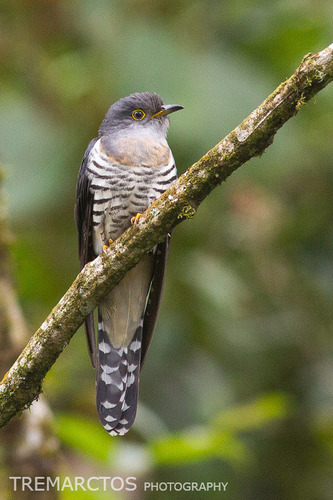
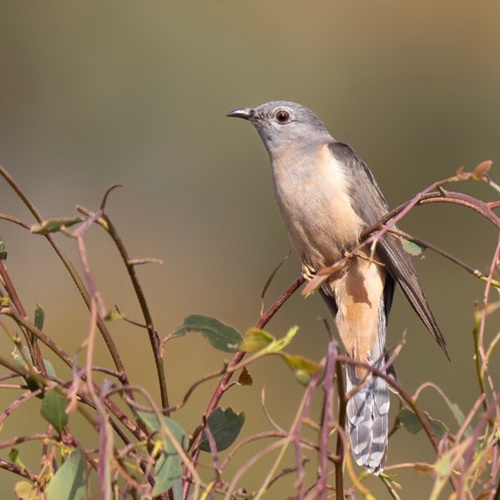
This is the subspecies Cacomantis variolosus sepulcralis of the Sahul brush cuckoo. The Sahul brush cuckoo measures approximately 22 to 26 centimeters (8.7 to 10.2 inches) in length. Adult males and females have identical plumage: the head is pale grey, the breast is buff, the back is grey-brown, and the underside of the tail is brown with white tips and white bars. A narrow pale ring surrounds the eye, and the feet are olive-pink. Juveniles have heavily barred dark brown plumage. In flight, the wings are sharply pointed and backswept; underwings are grey-brown with pale buff underwing coverts and a white or pale buff bar. The Sahul brush cuckoo looks similar to the pallid cuckoo, and is especially similar in appearance to the fan-tailed cuckoo and the chestnut-breasted cuckoo.
The Sahul brush cuckoo occurs in northern and eastern Australia, New Guinea, the Solomon Islands, Malaysia, and other islands located north of Australia. It is a resident species across parts of its range, including Thailand, peninsular Malaysia, Cambodia, southern Vietnam, the Philippines, the Greater Sunda Islands, the Lesser Sunda Islands, the Maluku Islands, and Timor. It may undertake local migration in New Guinea and northern Melanesia. In the southern portion of its Australian range, the species is migratory. Within Australia, it lives in a variety of habitats, including rainforests, rainforest edges, mangrove forests, secondary forests, and plantations.
The Sahul brush cuckoo is a brood parasite. Its eggs are polymorphic, so individual females lay specific egg types matched to specific host species. In Australia, females lay three distinct egg types, which correspond to their major host in the local region they occupy. Across its Australian range, the Sahul brush cuckoo uses at least 58 other bird species as hosts, though only a small number of these host species have been observed raising cuckoo chicks to fledging. The host species that do raise chicks to fledging differ between Sahul brush cuckoo subspecies. For the subspecies C. v. dumetorum, these hosts include the purple-crowned fairywren, brown-backed honeyeater, and bar-breasted honeyeater. For the subspecies C. v. variolosus, these hosts include the rose robin, Norfolk robin, leaden flycatcher, restless flycatcher, satin flycatcher, rufous fantail, and grey fantail. In Indonesia, observed hosts of the local Sahul brush cuckoo subspecies include the grey-headed canary-flycatcher, Javan blue flycatcher, snowy-browed flycatcher, Sunda forktail, long-tailed shrike, striated grassbird, sooty-headed bulbul, yellow-vented bulbul, Malaysian pied fantail, rufous-tailed fantail, pied bush chat, Buru white-eye, and Sangkar white-eye.