About Cacomantis sonneratii (Latham, 1790)
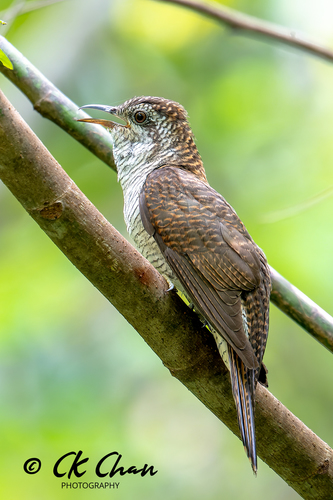
Adult Cacomantis sonneratii have bright rufous or bay coloration on the head and back, with broad dark brown barring across these areas. Their bill is long and slightly curved; a distinctive whitish supercilium sits above a dark eye-line. The wings are darker than the head and back, and the tail is graduated with a dark brown center. The tail also has a subterminal black band, and each feather has a white tip. The sexes are identical in appearance. Adults have yellow irises, a black upper mandible, and a greenish grey base to the lower mandible; their tarsi are grey. Juveniles resemble adults, but have a pale lower mandible and white fringes along the feathers of the upper body. This species reaches a total length of about 22 cm, which matches the size of the syntopic species Cacomantis merulinus and Cacomantis variolosus. The hepatic morphs of these two related species can look similar to Cacomantis sonneratii, but the latter is distinguished by its supercilium, long beak, and barred tail.
Like many other cuckoos, Cacomantis sonneratii is brood-parasitic. Recorded host species include the common iora, red-whiskered bulbul, white-bellied erpornis, scarlet minivet, other bulbuls, and small babblers of the genus Stachyris. The eggs of Cacomantis sonneratii resemble the eggs of their hosts. Details of incubation and nesting behavior are not well documented. The parasite evicts host fledglings from the nest. Populations of this species are often fully or partially migratory; in India, they are found mainly during the monsoon season. They inhabit well-wooded forests, primarily in hilly areas. Insects make up their primary diet, which they capture both by gleaning vegetation and through aerial sallying. The breeding season varies widely across different regions. Near Bombay, this species is known to lay eggs from February to August; in Assam, laying occurs from April to August. Birds in the Eastern Ghats sing through most of the year. In Sri Lanka, young birds have been observed in June and October, while adults on the Malay Peninsula sing from January to May. The call of this species is distinctive: it is a high-pitched four-note whistle, transcribed variously as "wee-ti wee-tee" or "smoke-yer-pepper". The call starts at a frequency of 2.4 kHz, each note drops in pitch, and the full strophe lasts one second.