About Cacomantis merulinus (Scopoli, 1786)
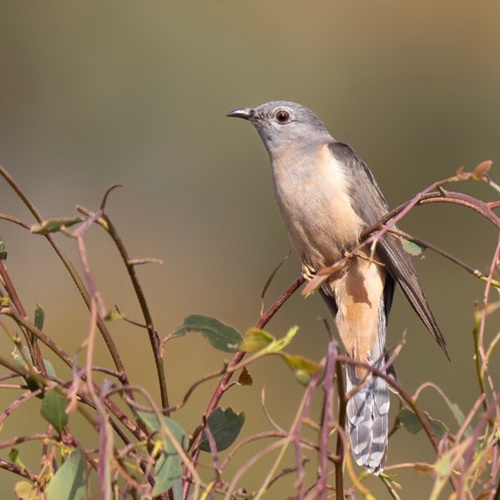
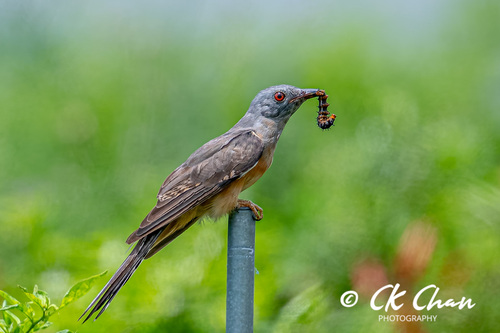
The plaintive cuckoo, Cacomantis merulinus (Scopoli, 1786), is a fairly small species, measuring approximately 21–24 cm (8.3–9.4 in) in total length. Adult males are grey-brown on their upper bodies, with orange underparts, and a grey head, throat and upper breast. Their tail feathers have white tips. Their legs and feet are yellow, eyes are red, and the bill is black on the upper half and yellow on the lower half. Adult females sometimes match the appearance of males, but they often occur in a distinct "hepatic" color morph. This hepatic morph is reddish-brown on the upper body with dark bars, has paler underparts with much fainter barring, a pale stripe running over the eye, and dark bars along the entire length of the tail. Juvenile plaintive cuckoos look similar to hepatic morph females, but are paler overall, and have dark streaks rather than bars on the crown and throat. Males produce several types of plaintive whistling calls: these include an ascending series of three-note phrases, and a series of 11 or 12 descending notes. There are four recognized subspecies of plaintive cuckoo. The nominate subspecies, C. m. merulinus, is found in the Philippines, where it is common across many of the larger islands. C. m. querulus is the most widespread subspecies, occurring in northeast India, Bangladesh, southern China, Indonesia, Myanmar, Thailand, Cambodia, Laos and Vietnam; across most of its Chinese range it is a summer visitor, migrating south for the winter. C. m. threnodes inhabits the Malay Peninsula, Sumatra and Borneo, while C. m. lanceolatus occurs on Java, Bali and Sulawesi. The grey-bellied cuckoo, C. passerinus, was formerly classified as a subspecies of the plaintive cuckoo, but is now widely treated as a separate species. Plaintive cuckoos live in a variety of habitats including forest edge, open woodland, scrub, grassland, farmland, parks and gardens. They feed on invertebrates, are normally solitary, and are often difficult to spot. They are brood parasites, laying their eggs in the nests of host species including cisticolas, prinias and tailorbirds. Their eggs are similar in appearance to the host's own eggs, but are larger in size. Small host birds often mob the plaintive cuckoo to drive it away from their nesting sites.