About Cacicus uropygialis Lafresnaye, 1843
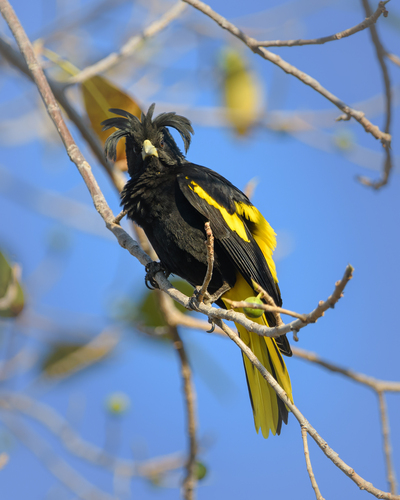
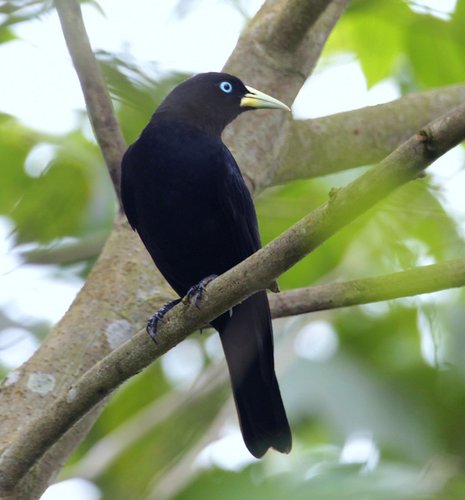
The subtropical cacique (Cacicus uropygialis) is a member of the Icteridae family, and like many species in this group, it is sexually dimorphic, with the difference between sexes lying mainly in size. Males measure 25 cm (10 in) long, slightly larger than scarlet-rumped caciques, a size difference that follows Bergmann's Rule. This species is a slim, long-winged bird with a relatively short tail, blue eyes, and a pale yellow pointed bill. Most of its plumage is black, except for a scarlet patch located on the lower back and upper rump. Females are smaller and have duller black plumage than males, while juvenile birds have brownish overall plumage and a brownish-orange rump. The calls and songs of the subtropical cacique are not typical for icterids, and instead resemble the chatter of an excited great thrush (Turdus fuscater). Subtropical caciques occur along Andean slopes at altitudes between 1,000–2,300 m (3,300–7,500 ft), and have been recorded as high as 2,450 m (8,040 ft) above sea level. They inhabit submontane forest or cloud forest, ranging from Venezuela through Colombia and Ecuador to Peru, with an isolated population in the Serranía del Perijá. Their habitat has a lower canopy than the habitat of scarlet-rumped caciques, and is dominated by trees that grow to just over 15–20 m (49–66 ft) high. Typical habitat features include oaks (Quercus), epiphytes, hemiepiphytes such as Coussapoa from the Urticaceae family, and a usually dense understory containing tree ferns and Ericaceae, among other plants. These caciques forage through the canopy in small flocks. Their diet consists of large insects, spiders, and small vertebrates, and they also consume some fruit. They often join mixed-species feeding flocks with other robust, loud songbirds, including other icterids, black-faced grosbeaks (Caryothraustes poliogaster), and American jays. These noisy flocks may in turn attract trogons or flycatchers. Unlike some other cacique species, subtropical caciques are not usually colonial breeders, though they do build the bag-shaped nest that is typical of the group. The nest is constructed 3.5–30 m (11–98 ft) above ground, in a tree that usually also holds an active wasp nest. The bird's nest measures 36–64 cm (14–25 in) long, widens at the base, and is suspended from the end of a branch. A normal clutch holds two white eggs marked with dark blotches. Males help feed the young, but do not take part in incubation. The subtropical cacique is generally uncommon to rare, but its extensive range means it is unlikely to face serious threat.