About Cacicus solitarius (Vieillot, 1816)
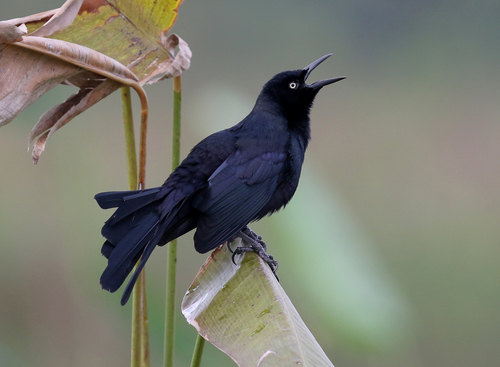
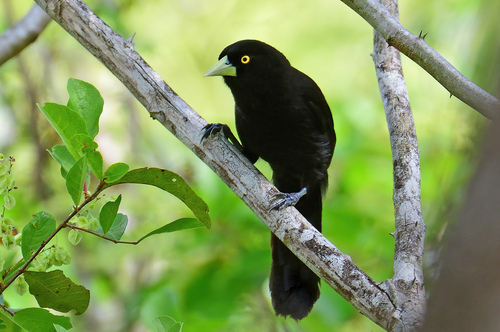
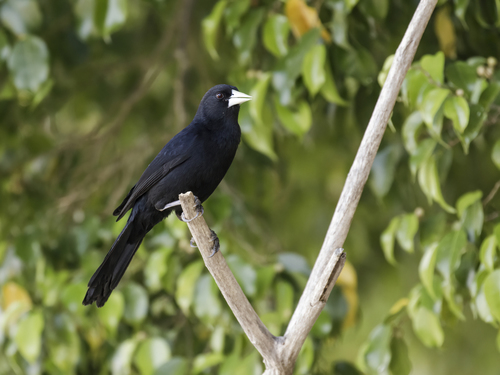
Male solitary caciques (Cacicus solitarius) reach about 27 cm (10.6 in) in length, while females reach 23 cm (9.1 in). Within its range, it can be distinguished from all other entirely black birds with dark irises by its large, white, chisel-shaped, sharply-pointed beak. It may be confused with the Ecuadorian cacique (Cacicus sclateri), which is smaller and has a restricted range, or the yellow-billed cacique (Amblycercus holosericeus), which does not occur east of the Andes. It produces a range of vocalizations, most delivered at a steady pace and sometimes interrupted by gurgles and growls. The solitary cacique has a very wide distribution across Amazonia, with its range extending south to northern Argentina and Uruguay, occurring at altitudes up to around 800 m (2,625 ft). It lives in forests, gallery forests, and flooded areas, and is typically found in the mid-storey of the canopy or the shrubby understorey, often clambering through dense vines. This species is usually seen alone or in pairs, and does not join mixed-species or other bird flocks. It forages acrobatically in tangled undergrowth, sometimes hanging upside down, and will occasionally visit flowering trees in higher canopy levels. Its diet includes invertebrates, small vertebrates such as tree frogs, as well as fruit and nectar. Breeding occurs between October and January depending on location; in Argentina, it is thought to raise two broods per breeding season. Unlike many other species in the genus Cacicus that build nests in colonies, the solitary cacique nests alone.