About Cacicus haemorrhous (Linnaeus, 1766)
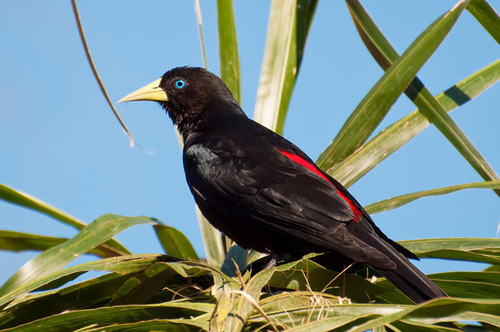
The red-rumped cacique (Cacicus haemorrhous) is a bird species in the Icteridae family. It has two separate, non-overlapping ranges in South America. One range covers the Amazon Basin and the Guyanas in northern South America, where it only occurs along the coast in the Guyanas and the outlet of the Amazon River to the Atlantic. The other large separate range covers all of southeastern and coastal Brazil, including Paraguay, and parts of northeastern Argentina. This species is also found in Bolivia, Brazil, Colombia, Ecuador, French Guiana, Guyana, Peru, Suriname, and Venezuela. Its natural habitats are subtropical or tropical moist lowland forests, subtropical or tropical swamps, and heavily degraded former forest. In 1760, French zoologist Mathurin Jacques Brisson published a description of the red-rumped cacique in his work Ornithologie, based on a specimen collected from Cayenne in French Guiana. He gave the species the French name Le cassique rouge and the Latin name Cassicus ruber. The names Brisson coined do not follow the binomial system, so they are not recognized by the International Commission on Zoological Nomenclature. In 1766, Swedish naturalist Carl Linnaeus updated his Systema Naturae for its twelfth edition, adding 240 species that Brisson had previously described, including the red-rumped cacique. Linnaeus provided a brief description of the species, created the binomial name Oriolus haemorrhous, and cited Brisson's earlier work. The specific name haemorrhous comes from the Ancient Greek words haima meaning "blood" and orrhos meaning "rump". This species is now classified as the type species of the genus Cacicus, which was introduced by French naturalist Bernard Germain de Lacépède in 1799.