About Cacatua sanguinea Gould, 1843
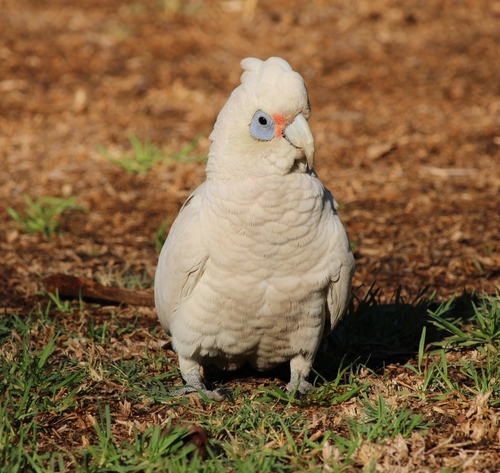
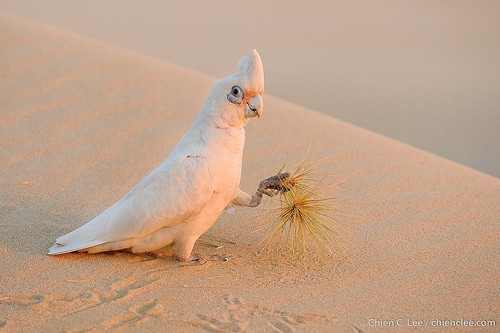
This species, the little corella, is a small white cockatoo. It grows to 35–41 cm (14–16 in) in length, and weighs 370–630 g (13–22 oz), with an average weight of 525 g (1.157 lb). It looks similar to both the long-billed corella and the western corella, but the little corella is smaller. Unlike the two similar species, it has upper and lower mandibles of similar length. It can be easily told apart from the long-billed corella by its lack of an orange throat bar. The subspecies C. s. normantoni and C. s. transfreta are slightly smaller than the nominate subspecies. C. s. normantoni has a light brownish tint on the underside of its flight and tail feathers. C. s. gymnopis has darker blue eye-rings, more strongly marked pink lores, and a yellow wash to the lower-ear coverts. Females are slightly smaller than males across multiple measurements: weight, wing length, culmen size, tarsus length, tail length, and eye ring diameter. The little corella is native to mainland Australia, where it occurs in a broad arc from eastern South Australia through Victoria, New South Wales, Queensland and the Northern Territory, extending to coastal Western Australia. It is also native to southern New Guinea, and has been introduced to Tasmania. The nominate subspecies C. s. sanguinea is found in northern Australia. C. s. normantoni occurs on the Western Cape York Peninsula. C. s. transfreta is found in New Guinea. C. s. gymnopis is found in Central, Eastern, and South-eastern Australia. Its natural habitats include savanna, shrubland, and grassland; it can also live in urban settings. Its range spans from the arid deserts of central Australia to the eastern coastal plains, but it is not found in thick forests. Little corellas also live in urban areas including Melbourne, Canberra, Sydney and Brisbane, where they feed on lawns and playing fields. They are numerous in farmlands throughout New South Wales and Queensland. They have become so common in some areas that they are considered crop pests, and can damage perching trees by chewing bark off smaller twigs.