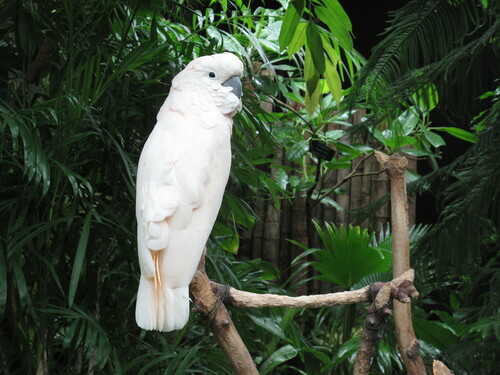
About Cacatua moluccensis (Gmelin, 1788)
The salmon-crested cockatoo, with the scientific name Cacatua moluccensis, is also commonly called the Moluccan cockatoo. This species of cockatoo is endemic to the Seram archipelago in eastern Indonesia. It reaches up to 46 to 52 cm (1.51 to 1.71 ft) in height and up to 850 g (1.87 lb) in weight, placing it among the largest of the white cockatoos. On average, females are slightly smaller than males. Its body feathers are white-pink with a distinct peachy glow. It has slight yellow coloring on the underwing and the underside of its tail feathers, along with a large retractable recumbent crest. This crest is raised when the bird is threatened, revealing previously hidden bright red-orange plumes to frighten potential attackers. The crest may also be raised when the bird is excited, or during other emotional displays. Some people describe the crest's exposed plumes as flamingo-colored. This cockatoo has one of the loudest calls of any parrot species, and captive individuals are capable mimics. In the wild, the salmon-crested cockatoo lives in lowland forests located below 1,000 metres (3,300 feet). Its diet is made up primarily of seeds, nuts, fruit, and coconuts. There is additional evidence that wild individuals also eat insects collected from the ground. Pet Moluccan cockatoos have developed anemia when their diets do not contain enough protein. The salmon-crested cockatoo is endemic to the Seram archipelago in eastern Indonesia. It has been introduced to the Hawaiian island of Oahu, where a small population has become established. While wild individuals have been observed in Puerto Rico, these are almost certainly escaped pet birds, and no breeding population has been recorded there.