About Cacatua leadbeateri (Vigors, 1831)
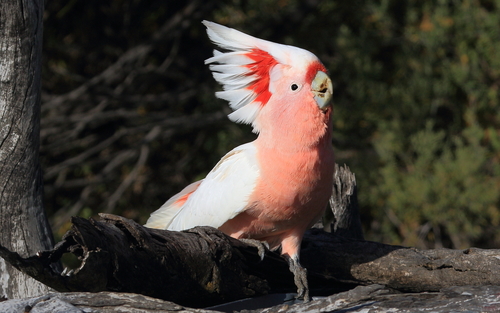
The pink cockatoo, scientifically known as Cacatua leadbeateri (Vigors, 1831), has soft-textured white and salmon-pink plumage, plus a large bright red and yellow crest. One of its former common names honored Major Thomas Mitchell, who wrote that few birds enliven the monotonous hues of the Australian forest more than this beautiful species, whose pink-coloured wings and flowing crest would have been fitting for a more voluptuous region. Adult female and male pink cockatoos are almost identical in appearance; males are typically larger, while females have a broader yellow stripe on the crest and develop a red eye when mature. Pink cockatoo populations have declined rather than increased due to human-caused changes to the arid interior of Australia, unlike populations of the galah. Where galahs easily settle in cleared and partially cleared land, pink cockatoos require extensive woodlands, and particularly favor conifers of the genus Callitris, sheoak of the genus Allocasuarina, and eucalypts. Unlike other cockatoos, breeding pairs of pink cockatoos will not nest close to one another, so they cannot tolerate fragmented, partially cleared habitats, and their range is contracting. In the Mallee region of Victoria where both galahs and pink cockatoos nest, the two species have interbred and produced hybrid offspring occasionally. Pink cockatoos are usually found in pairs or small groups, and feed both on the ground and in trees. Pink cockatoos reach sexual maturity around 3 to 4 years old. The oldest recorded pink cockatoo died at 83 years old.