About Cacatua alba (Statius Muller, 1776)
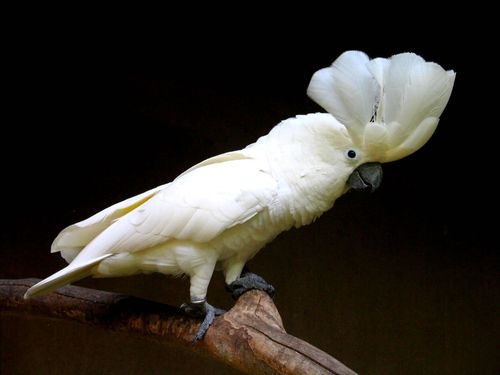
The white cockatoo (Cacatua alba) is around 46 cm (18 in) long. Body weight ranges from approximately 400 g (14 oz) for smaller females to up to 800 g (28 oz) for larger males. Males typically have broader heads and larger beaks than females. All white cockatoos have brown or black eyes and a dark grey beak. When mature, some females can have reddish-brown irises, while adult males have dark brown or black irises. Most of the species' feathers are white. However, both the upper and lower surfaces of the inner half of the trailing edge of the large wing feathers are yellow. The yellow color on the underside of the wings is most noticeable, because the yellow portion of the feather's upper surface is covered by the white of the feather immediately medial, that is closer to the body, and above. Similarly, areas of larger tail feathers that are covered by other tail feathers, and the innermost covered areas of the larger crest feathers, are yellow. Short white feathers grow from and closely cover the upper legs. The feathers of this species, like those of other related cockatoos, produce a powder similar to talcum powder that easily transfers to clothing. Like other cockatoos and parrots, the white cockatoo has zygodactyl feet: two toes face forward, and two face backward. This foot structure lets it grasp objects with one foot while standing on the other, for feeding and object manipulation. The maximum lifespan of the white cockatoo is not well documented. A few zoos report that captive individuals live 40 to 60 years, and anecdotal reports suggest they can live even longer. Lifespan in the wild is unknown, but is believed to be up to ten years shorter than captive lifespan. Cacatua alba is endemic to lowland tropical rainforest on the Moluccan islands of Halmahera, Bacan, Ternate, Tidore, Kasiruta and Mandioli, part of the Bacan group, in North Maluku, Indonesia. Records of the species from Obi and Bisa, part of the Obi group, are thought to come from introduced populations. There is also a locally breeding introduced population on Taiwan. It occurs in primary, logged, and secondary forests below 900 meters elevation. It can also be found in mangroves and plantations, including coconut plantations and other agricultural land. The species remains locally common. In 1991–1992, its total population was estimated at 42,545 to 183,129 birds. This estimate may be an underestimate, because it was largely based on surveys from Bacan, rather than Halmahera where the species may be more common. Recent observations indicate that rapid population declines are ongoing, and are predicted to increase in the future. CITES data shows significant harvest rates for the cage bird trade during the early 1990s. Annual harvests have declined in actual numbers and as a proportion of the remaining population in recent years, but illegal trade continues and is likely to have been underestimated.