About Bycanistes subcylindricus (P.L.Sclater, 1871)
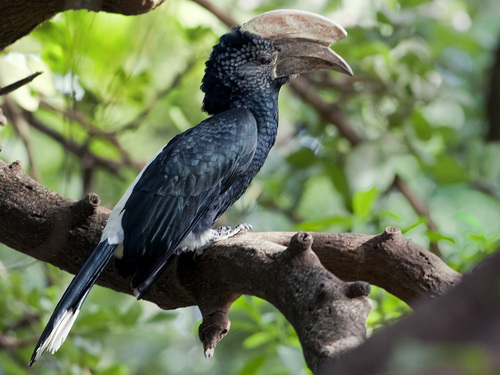
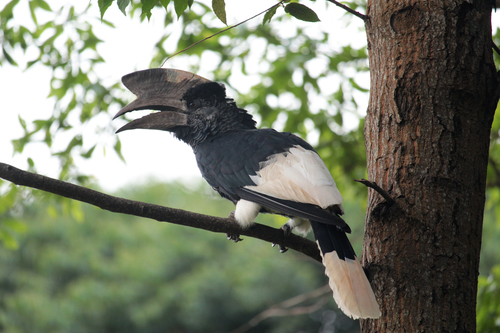
Bycanistes subcylindricus, commonly called the black-and-white-casqued hornbill, is a moderately large bird, measuring 60 to 70 cm in length with a wingspan of 70 to 96 cm. Males weigh between 1 kg and 1.5 kg, while females weigh between 1 kg and 1.25 kg. This species can be recognized by its black plumage covering the upper body and wings, and white plumage on the lower body and wings. Black feathers appear among the white feathers of its tail, particularly at the top of the tail and at the base of the tail feathers. It has a yellow-brownish bill and a flattened casque, both of which are enlarged in males; females have a smaller casque and a black bill. The function of the male casque is not confirmed, though it has been suggested to play a role in sexual identification. The black-and-white-casqued hornbill has very mobile eyes, an uncommon trait among birds: its eyes can move within their sockets, while most other birds must move their heads to change their field of vision. It can also convey emotions through the feathers on the top of its head, letting it communicate its emotional state. This hornbill occurs in wooded habitats across central and western Africa. Its range extends from western Kenya to Côte d'Ivoire, with an isolated population in northern Angola. West African populations are mostly concentrated in Côte d'Ivoire, with smaller populations in surrounding countries. Central African populations are mostly found in Uganda, Kenya, and Cameroon, with smaller populations in Gabon, Tanzania, and other parts of Central Africa. It is a tropical arboreal species that inhabits regions with extensive forest cover, and is rarely seen on flat lowlands.