About Byasa polyeuctes (Doubleday, 1842)
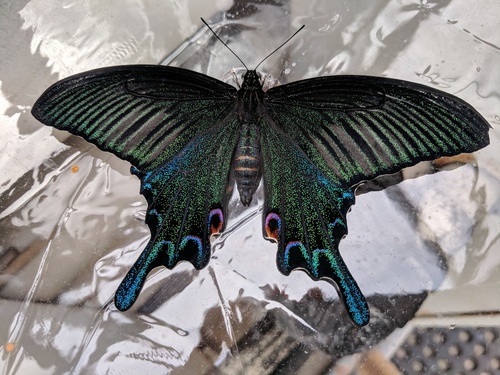
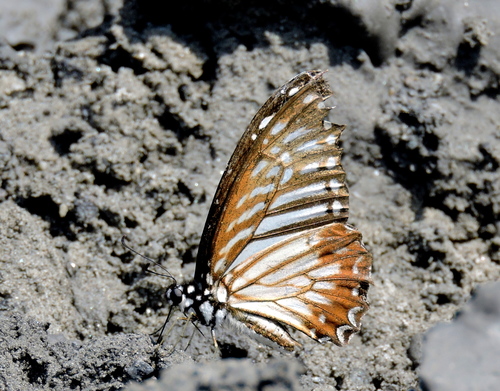
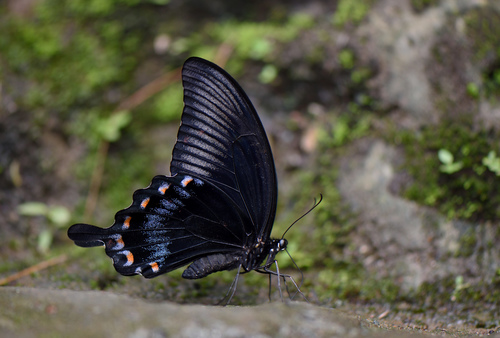
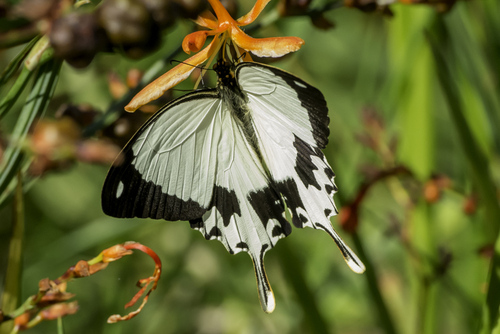
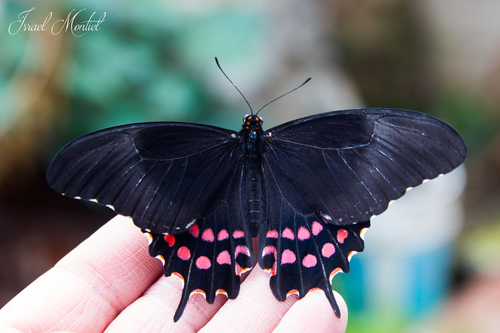
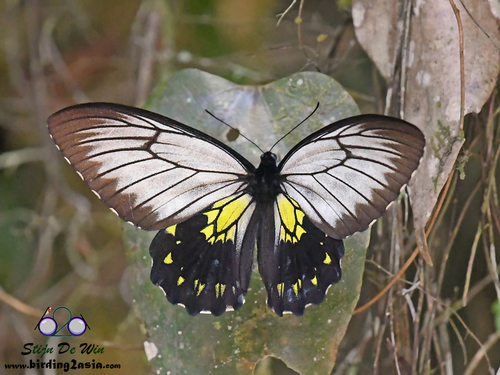
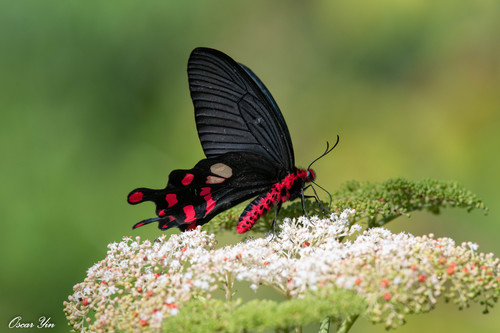
This species, Byasa polyeuctes, has a wingspan ranging from 110 to 140 mm. The sexes have identical appearance. The upper side of the wings is black and white, and the species has a prominent swallowtail shape on its wings. The body is red, and the tail has a red tip. The forewings are completely black on both the upper and undersides. The hindwings have two deep crenulations on each side of the swallowtail. They have a large oblong white discal spot in wing cell 5, visible on both the upperside and underside; this spot may sometimes also be present in cell 4. The upperside of the hindwing features irregular marginal red crescents in cells 1a, 2, and 3, along with a small white spot in cell 4. This butterfly is distributed across Pakistan, the northern ranges of India, Nepal, Bhutan, Myanmar, northern Thailand, Laos, Vietnam, southern China (including Yunnan), and Taiwan. Within India, it can be found across the Himalayas from Himachal Pradesh to Sikkim and Assam, extending into the South Tibet region of China and northern Myanmar. It prefers forest and woodland habitats, and frequently occurs in river valleys. In northeast India, it occurs at low elevations between 1,000 to 5,000 feet (300 to 1,520 m); at the western extent of its range in Kashmir, it can be found at higher altitudes up to 11,000 feet (3,400 m). In climates that suit this species, it produces multiple broods per year. Adults can be found on the wing from April through September. Adult Byasa polyeuctes have a foul odor. The recorded larval food plants are Nepenthes species from the family Nepenthaceae, and Aristolochia griffithi and Aristolochia shimadai from the family Aristolochiaceae.