About Buxus sempervirens L.
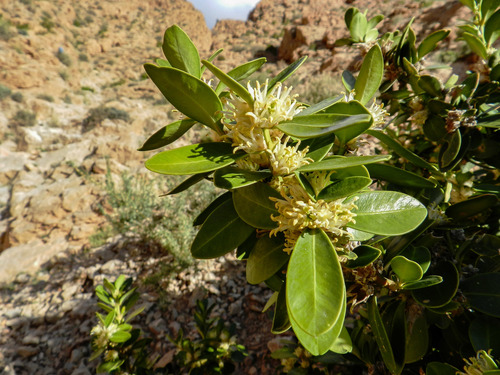
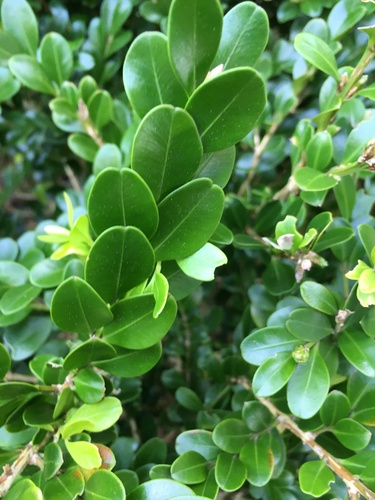
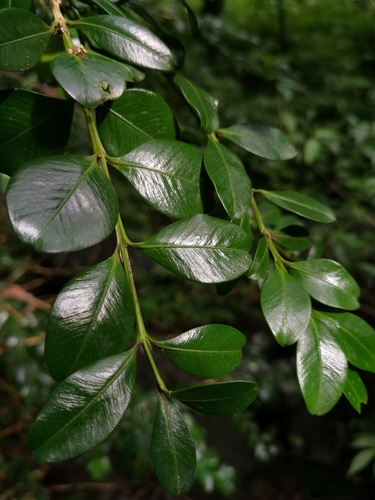
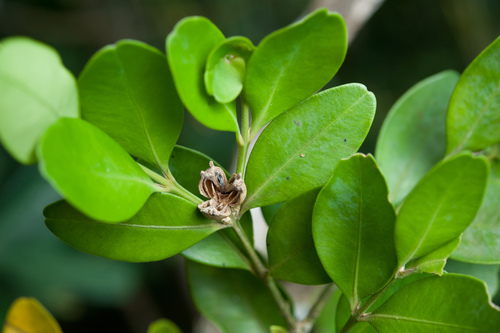
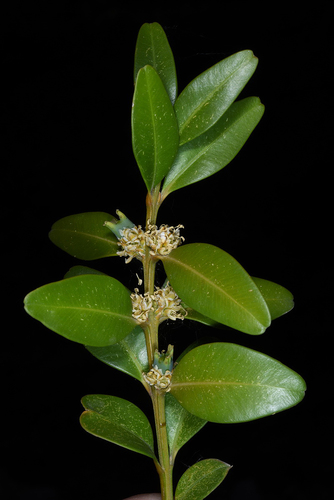
Buxus sempervirens L., commonly known as common box or boxwood, is an evergreen shrub or small tree. It typically grows 1 to 9 m (3 to 30 ft) tall, with a trunk up to 20 centimetres (8 in) in diameter; exceptionally large specimens can reach 10 m tall with a 45 cm diameter trunk. Its leaves are arranged in opposite pairs along stems, and are green to yellow-green, oval, 1.5–3 cm long, and 0.5–1.3 cm broad. This species is monoecious, producing inconspicuous but strongly scented greenish-yellow flowers that have no petals and are pollinated by insects. Its fruit is a three-lobed capsule that holds three to six seeds. In its native range, Buxus sempervirens typically grows on soils derived from chalk and limestone. It most often grows as understorey in forests of larger trees, most commonly in association with European beech (Fagus sylvatica) forests. It can also sometimes be found in open dry montane scrub, particularly in the Mediterranean region. Box Hill, Surrey, England is named after its notable box population, which makes up the largest area of native box woodland in England. The species is also locally naturalised in parts of North America. In Britain, four Roman burials included coffins with sprays of this evergreen box, a practice that has not been recorded anywhere else in Europe. Box leaves have also been recovered from several Roman British towns, villas, and farmsteads, which indicates the plant was grown ornamentally here in this era. Box remains a very popular ornamental plant for gardens, and is particularly valued for topiary and hedges due to its small leaves, evergreen growth habit, tolerance of close shearing, and scented foliage. However, not everyone enjoys the plant's scent: 16th century herbalist John Gerard described it as "evil and lothsome", and Daniel Defoe recorded that Queen Anne had the box hedging at Hampton Court Palace removed because she found its odour offensive. In the American South, this plant has sometimes been called "rich man's hedge", and was often used to anchor landscape plantings on either side of a house's front door. Its scent is most pungent on warm summer days; it has been compared to cat urine, but not all people find it disagreeable. Several cultivars have been selected for garden use, including 'Argenteo-variegata' and 'Marginata' which have variegated foliage. This type of "gilded box" was first documented in John Parkinson's 1629 work Paradisi in Sole Paradisus Terrestris. 'Vardar Valley' is a slow-growing, particularly hardy semi-dwarf cultivar. It was selected in 1935 by American botanist Edward Anderson in the upper Vardar valley, and sent to the Arnold Arboretum for evaluation. Two cultivars, B. sempervirens 'Elegantissima' and B. sempervirens 'Latifolia Maculata', have gained the Royal Horticultural Society's Award of Garden Merit. Boxwood is linked to the Hebrew word תְאַשּׁוּר tə’aššûr that is mentioned frequently in the Book of Isaiah. In Catholic households in climates where palms are scarce or do not grow, boxwood twigs are often used instead of palms to adorn crosses on Palm Sunday. Buxus sempervirens has a history of medicinal use. Its leaves were formerly used as a substitute for quinine and as a fever reducer. The species was not used medicinally until the early 1600s. After this time, it was found that the leaves (which contain alkaloids, oils and tannin), bark (which contains chlorophyll, wax, resin, lignin and minerals), and wood oil all had medicinal effects. It was subsequently used to treat gout, urinary tract infections, intestinal worms, chronic skin problems, syphilis, hemorrhoids, epilepsy, and headache, and also gained a reputation for curing leprosy, rheumatism, HIV, fever and malaria. It was specifically used as a quinine substitute to treat malaria, but it is no longer commonly used for these conditions due to its side effects and the availability of more effective medicinal alternatives. Homeopaths still use the leaves of this species to treat rheumatism. While herbalists have used box leaf tea to lower fevers, this use is very rare today. In Turkey, where the plant is called Adi şimşir, one glass of this tea per day is still consumed for its antihelminthic, diaphoretic, and cholagogue effects. Buxus sempervirens leaves were also historically used to make an auburn hair dye. This plant has been extensively studied chemically. In the late 1980s, Dildar Ahmed isolated a number of steroidal alkaloids from the plant's leaves while working on his PhD thesis under the supervision of Prof Atta-ur-Rahman. A new nomenclature system for buxus alkaloids was also proposed, based on the buxane nucleus. Ahmed also isolated a flavonoid glycoside, which he named galactobuxin because it contains a galactose ring. It contains steroidal alkaloids such as cyclobuxine, and also contains flavonoids.