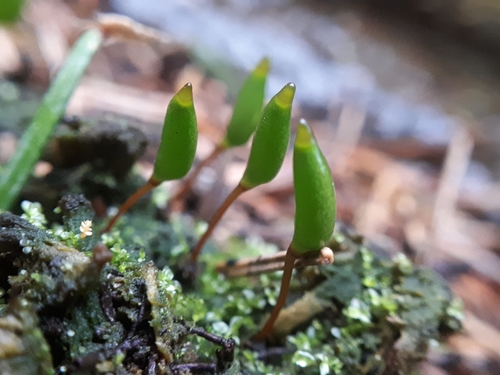
About Buxbaumia viridis (Moug. ex DC.) Brid. ex Moug. & Nestl.
Buxbaumia viridis, commonly called the green shield-moss, is a rare bryophyte that occurs sporadically throughout the northern hemisphere. The gametophyte of this moss cannot be seen with the naked eye; only its large, distinct sporophyte serves as an identifying structure for the species. It grows either singly or in small groups on decaying wood, most often in humid, sub-alpine to alpine forests dominated by Picea abies, Abies alba, or mixtures of these trees. Because B. viridis is rare, active conservation efforts are underway in most countries where it occurs.
This moss is an epixylic species, meaning it grows on wood surfaces. It strongly prefers heavily decayed wood, typically decayed to the point of deformation; this stage of decay occurs 30–60 years after a tree falls, depending on the tree species and size. While it does not grow only on a single tree species, it is encountered much more often on conifers such as Picea abies and Abies alba. It can also grow on other conifers and deciduous tree species including Fagus sylvatica. Rarely, it may be found growing on mineral soil or humus. For survival, B. viridis requires constant humidity and shady or sheltered locations. Dry conditions cause protonema death, reduced spore production, and lower germination rates. It is restricted to sub-alpine to alpine forests that contain abundant large decaying wood.
Across the northern hemisphere, B. viridis has a wide overall distribution, but its populations are scattered and individual plants are uncommon. It is found across most of Europe, southwestern Asia, and western North America.
Ecologically, B. viridis is a poor competitor, most likely because it spends most of its life cycle as protonema. It regularly co-occurs with a number of other moss and liverwort species including Herzogiella seligeri, Rhizomnium punctatum, Dicranum scoparium, Tetraphis pellucida, and Chiloscyphus profundus. This species is dioicous, has low fertilization rates, and is not tolerant of desiccation; all these factors combine to give it very low establishment rates for new populations. Fertilization of archegonia occurs from mid-spring to early summer, and sporophyte maturation and spore dispersal takes place from late spring to early summer. B. viridis is not a long-lived species because of the nature of its preferred substrate. The advanced stage of decay of its growing substrate makes it vulnerable to rapid change, so the species may not be found at the same site year after year. It requires a large amount of heavily decayed wood to support current growth and future new establishment, and the amount of strongly decayed wood in an area is a reliable predictor of B. viridis presence.
Herbivory on B. viridis sporophytes has been observed, a behavior not often reported for mosses. Cut setas have been found, though the organism responsible is unknown. Small slugs of the genus Arion have been observed scraping the outer layer of B. viridis capsules to eat the spores inside. This slug herbivory is not thought to provide any benefit to the moss, and it causes around 30% of all sporophytes to be lost. Because B. viridis can persist as protonema without producing a visible sporophyte, it is very likely that the actual number of individual plants is higher than the number that have been officially recorded.

