About Butyriboletus frostii (J.L.Russell) G.Wu, Kuan Zhao & Zhu L.Yang
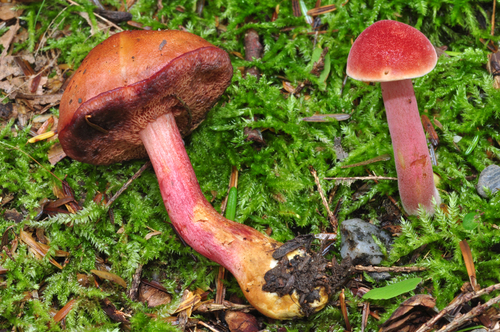
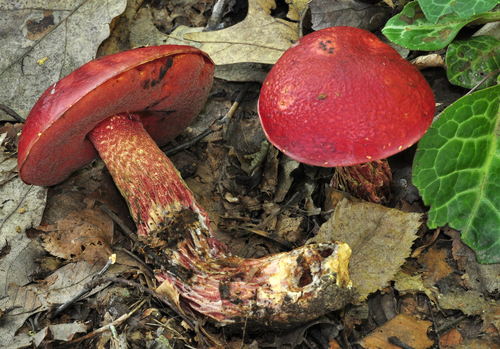
Butyriboletus frostii, also historically referenced under the names Exsudoporus frostii and Boletus frostii, produces fruiting bodies that change shape as they mature. Young fruit bodies have caps that range from hemispherical to convex; as they age, caps become broadly convex, flat, or shallowly depressed, and reach a diameter of 5–15 cm (2.0–5.9 in). The cap edge curves inward when young, and uncurls and turns upward with age. When growing in moist conditions, the cap surface is sticky, due to a cuticle formed from gelatinized hyphae. After rain, when the fruit body dries out, the cap becomes particularly shiny, and sometimes develops a fine areolate pattern of small block-like sections resembling cracked dried mud. Young mushrooms bear a whitish bloom on the cap surface. Cap color starts bright red and fades as the mushroom ages. The flesh is up to 2.5 cm (1.0 in) thick, and varies in color from pallid to pale yellow to lemon yellow. When bruised, the flesh shows a variable blue staining reaction: some specimens turn deep blue almost immediately, while others turn blue weakly and slowly. The mushroom’s taste and odor are described as pleasant or sweet, and somewhat similar to citrus, though the cap cuticle may have an acidic taste. The tubes that make up the pore-like hymenium (spore-bearing surface) are 9–15 mm deep. They are yellow to olivaceous (mustard) yellow, and turn dingy blue when bruised. The pores are small (2 to 3 per mm), circular, and stay a deep red until old age, when they eventually pale. Young pore surfaces are often covered in bead-like yellowish droplets, which is a distinguishing characteristic, and the pore surface readily turns blue when bruised. The stipe measures 4 to 12 cm (1.6 to 4.7 in) long, and 1 to 2.5 cm (0.4 to 1.0 in) thick at its apex. It is roughly equal in thickness along its entire length, though it may taper slightly toward the top; some specimens appear ventricose, or swollen in the middle. Most of the stipe surface is red, and it is yellowish near the base. The stipe surface is reticulate, marked with net-like ridges. Yellowish white to light yellow mycelia are visible at the stipe base. The spore print of B. frostii is olive brown. Its spores are thick-walled, smooth, and spindle-shaped, with dimensions of 11–15 by 4–5 μm; longer spores up to 18 μm long may also occur. The cap cuticle (pileipellis) is a tangled layer of gelatinized hyphae that are 3–6 μm wide. The spore-bearing basidia are four-spored, and measure 26–35 by 10.5–11.5 μm. Non-fertile cystidia cells are interspersed among the basidia, and are abundant in the hymenial tissue. These translucent hyaline cells measure 30–53 μm long by 7.5–14 μm wide, and range in shape from somewhat spindle-shaped (tapering at each end, with one end typically rounded) to subampullaceous, similar in shape to a swollen bottle. B. frostii is a mycorrhizal species, meaning it forms symbiotic associations with the roots of various tree species. This mycorrhizal relationship is mutualistic: the fungus absorbs mineral nutrients from soil and delivers them to the host plant, and the host plant provides the fungus with sugars produced via photosynthesis. A defining feature of this mycorrhiza is a sheath of fungal tissue that wraps around the host’s small terminal nutrient-absorbing rootlets. The fungus grows an extensive underground network of hyphae that spreads outward from the root sheath, increasing the total surface area available for nutrient absorption. Hyphae also grow between the root’s cortical cells to form a structure called a Hartig net. Pure culture experiments have confirmed B. frostii can form mycorrhizae with Virginia pine (Pinus virginiana), and a field study has confirmed a similar association with the oak Quercus laurina. Fruit bodies grow singly, scattered, or in groups on the ground under hardwood trees. Fruiting occurs from summer to early autumn, between June and September in eastern North America. Observers have noted the fungus prefers open thin oak woods where enough light reaches the ground to support grass growth, and thin sandy soil under scrub oak. In the United States, it is distributed from Maine south to Georgia, extending west to Tennessee and Michigan, and also occurs in southern Arizona. In Mexico, it is often found growing under madrone trees. It has also been collected in Costa Rica, where it associates with the oak species Quercus copeyensis, Q. costaricensis, Q. rapurahuensis, and Q. seemanii. A 1980 publication tentatively suggested the species was present in Italy, but the author later determined the identified specimen was actually Boletus siculus, which is now synonymized into Exsudoporus permagnificus. Fruit bodies of B. frostii can be parasitized by the mold-like fungus Sepedonium ampullosporum. Infection causes necrosis of mushroom tissue, and turns the tissue yellow due to the production of large amounts of pigmented aleurioconidia, which are single-celled conidia formed by extrusion from conidiophores.