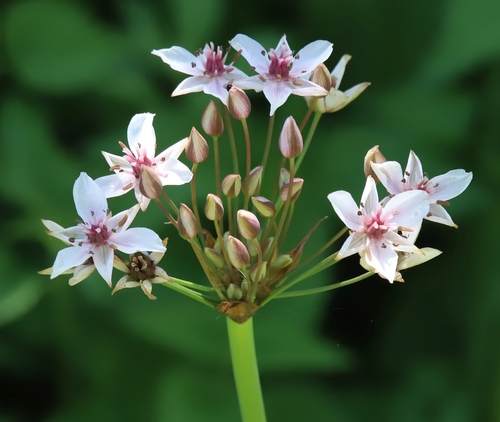
About Butomus umbellatus L.
Contrary to what its English common name suggests, Butomus umbellatus L. is not a true rush. It is native to continents of the Old World, and grows along the margins of still or slow-moving water at depths up to around 3 meters. This species produces pink flowers. It has linear, pointed leaves that can reach 1 meter in length or longer. The leaves are triangular in cross-section, grow in two rows along the rhizome or base, are untoothed, have parallel veins, and are twisted. Its inflorescence is umbel-like, made up of a single terminal flower surrounded by three cymes. The flowers are regular and bisexual, and measure 2 to 3 cm across. The flowers have three petal-like sepals that are pink with darker veins, and these sepals remain attached through fruit development. The three petals match the sepals in appearance but are somewhat larger. Flowers have 6 to 9 stamens. Carpels are superior, number 6 to 9, and are slightly joined at their base. When ripe, carpels are obovoid and crowned with a persistent style. Numerous ovules are scattered across the inner surface of the carpel wall, excluding the midrib and edges. The fruit is a follicle. Its seeds have no endosperm and contain a straight embryo. Butomus umbellatus L. flowers from July through August. This species is cultivated as an ornamental plant for waterside locations. In parts of Russia, its rhizomes are eaten as food.

