About Buteo rufofuscus (J.R.Forster, 1798)
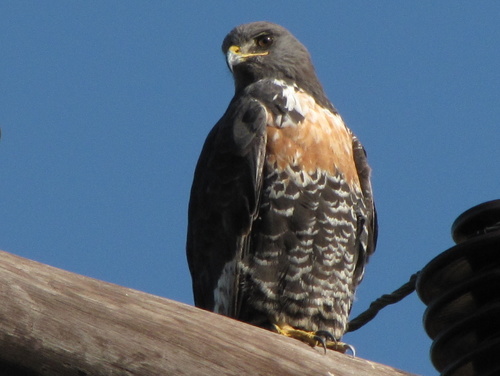
The jackal buzzard (Buteo rufofuscus) is one of two large Buteo species native to Africa, along with its close relative the augur buzzard. Adult jackal buzzards measure 44 to 60 cm (17 to 24 inches) in total length. Multiple surveys have recorded variation in body mass: one survey of 55 unsexed birds found weights from 790 to 1,370 g (1.74 to 3.02 lb), while another recorded 7 males at 865 to 1,080 g (1.907 to 2.381 lb) and 11 females at 1,150 to 1,700 g (2.54 to 3.75 lb). An additional female weighed roughly 1,700 g (3.7 lb), confirming that this is one of the most massive Buteo species in the world. A sample of 18 jackal buzzards averaged 1,059.4 g (2.336 lb). The species' wingspan ranges from 127 to 143 cm (4 ft 2 in to 4 ft 8 in), with an average wingspan of 131.9 cm (4 ft 4 in) from a sample of 9 birds; this average is almost identical to the average wingspan of the augur buzzard. Adult jackal buzzards have strikingly patterned plumage and are often considered one of the most attractive buzzard species. While the upperparts, including the head, neck, and throat, are typically slate-grey, the underparts show extreme colour polymorphism. The most common plumage has a rich rufous breast patch, separated from the throat by an uneven white band, with a belly barred in black and white. In light morph individuals, the breast patch is mostly white or light rufous, while in dark (melanistic) morphs it is mostly black with little separation from the throat. This plumage variation is thought to be genetic, but a study found that the Mc1r gene linked to colour polymorphism in other bird species is not associated with colour variation in jackal buzzards, meaning other genes are likely responsible. The tail is usually rufous. Primary flight feathers are blackish and secondaries are off-white, both with black barring. From below, the flight feathers have a large white panel that contrasts with black on the outer hand and black wingtips that form a dark trailing edge to the wing. Compared to most other buzzards, other than the augur buzzard, the jackal buzzard has a very short tail, broad wings, a bulky body, and a large bill. Juvenile jackal buzzards are mainly brown on the upperparts, with a faded rufous-buff brown colour on the underparts. Worn feathers often appear as lighter buffy or whitish streaks. The juvenile tail is usually buff-brown, sometimes with a creamy pale tip. Juveniles have a black-tipped underwing with a whitish panel similar to adults, but the inner wing is rufous-buff, matching the body feathers, and streaked with brown. The jackal buzzard and augur buzzard only overlap in Namibia; the augur buzzard is typically distinctly paler at all life stages than the jackal buzzard, and particularly lacks the rich underpart colouring of adult jackal buzzards. However, both species have a melanistic form—melanism is much rarer in jackal buzzards than in augur buzzards, and the melanistic forms of the two species are very similar in appearance. They can usually only be told apart by the faint dark streaking present on the white wing panels of melanistic augur buzzards. Confusion with the slightly larger bateleur is unlikely; while the bateleur also has a short rufous tail, this larger, heavier eagle has very distinct head, wing, and body shapes, and clearly different adult colouration. Juvenile bateleurs may be confused with similarly brown juvenile jackal buzzards, but juvenile bateleurs are much darker on the underparts and have very different wing colour on their bulging wings. The jackal buzzard's call has a sharp, barking quality, and is transcribed as weeah ka-ka-ka or kyaahh-ka-ka-ka. The female's call is deeper than the male's. Its common name is thought to come from its call, which resembles the call of the black-backed jackal. The jackal buzzard's call has a lower tone than the call of the forest buzzard, and is very different from the harsh crowing call of the augur buzzard. It also resembles the call of the American red-tailed hawk. The jackal buzzard is endemic to southern Africa. Despite its restricted range, it is a fairly common raptor species. It lives across most of South Africa, absent from part of the north-central region but common in the country's northeast. Its range extends west into central Namibia, east through Lesotho and Eswatini into southern Mozambique, and west into extreme southeast Botswana. This is largely a mountain-dwelling species, but it can be found from low rocky outcrops and rocky terrain at sea level up to high mountain elevations of 3,500 m (11,500 ft) in Lesotho. Jackal buzzards can adapt to both arid, desert-like conditions and high-rainfall areas with dense vegetation. Most often, they prefer to stay close to grassland, where they do most of their hunting. Nesting density varies by location: a study in the Cape Peninsula found a low density of only 2.8 pairs per 100 km², while a study in the Lesotho highlands found a much higher density of up to 22.2 pairs per 100 km². In the Cape Peninsula, jackal buzzards preferred low-lying, south-facing cliffs for nesting sites.