About Buteo buteo (Linnaeus, 1758)
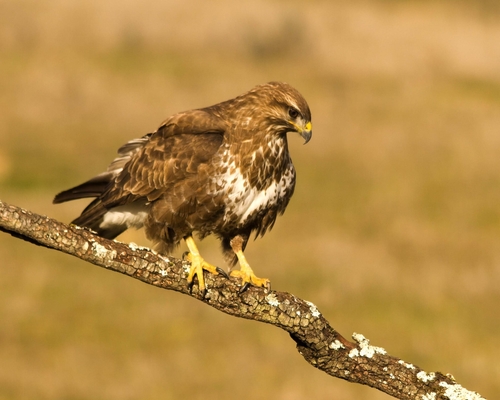
The common buzzard (Buteo buteo, first described by Linnaeus in 1758) is a medium-to-large raptor with highly variable plumage. Most common buzzards have a distinctly rounded head, a somewhat slender bill, relatively long wings that reach or fall slightly short of the tail tip when perched, a fairly short tail, and somewhat short, mostly bare tarsi. Their overall appearance can be fairly compact, but they look large compared to other common raptors like kestrels and sparrowhawks. The common buzzard measures 40 to 58 cm (1 ft 4 in to 1 ft 11 in) in total length, with a wingspan of 109 to 140 cm (3 ft 7 in to 4 ft 7 in). Females are on average 2 to 7% larger than males in linear measurements, and weigh around 15% more. Body mass varies considerably: for Great Britain populations, males range from 427 to 1,183 g (15 oz to 2 lb 10 oz), while females range from 486 to 1,370 g (1 lb 1 oz to 3 lb 0 oz).
Most typical nominate common buzzards (B. b. buteo) in Europe are dark brown on the upperparts, upperside of the head and mantle, becoming paler and warmer brown as plumage wears. The flight feathers of perched European nominate common buzzards are always brown. Most have a narrowly barred grey-brown and dark brown tail, with a pale tip and a broad dark subterminal band. Palest individuals can have varying amounts of white on the tail, a reduced subterminal band, or even an almost entirely white tail. Underside coloration is variable, but most individuals have a brown-streaked white throat and a somewhat darker chest. A pale U-shaped marking across the breast is often present, followed by a pale line running down the belly that separates the dark areas on the breast-side and flanks. These pale areas usually have highly variable markings that form irregular bars.
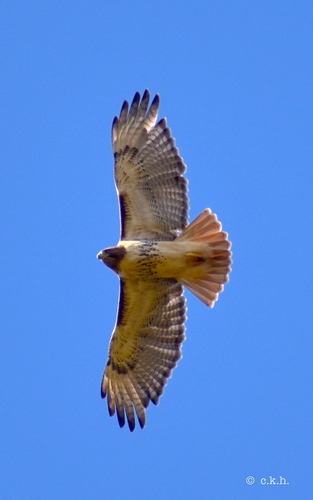
Juvenile nominate common buzzards are quite similar to adults, and can be most easily distinguished by a paler eye, a narrower subterminal tail band, and streaked rather than barred underside markings. Juveniles may also have variable creamy to rufous fringes on the upperwing coverts, but these are not always present. When viewed from below in flight, European common buzzards typically have a dark trailing edge to the wings. When viewed from above, one of the clearest identifying marks is their broad dark subterminal tail band. The flight feathers of typical European common buzzards are largely greyish, with dark wing linings at the front that contrast with a paler band along the median coverts. Paler individuals in flight usually have dark carpal patches that look like blackish arches or commas, but these may be indistinct in darker individuals or appear light brownish and faded in paler individuals. In flight, juvenile nominate common buzzards differ from adults by lacking a distinct subterminal tail band (instead having fairly even barring across the entire tail), having a less sharp, brownish rather than blackish trailing wing edge when viewed from below, and having streaked rather than barred paler areas of the underwing and body.
Beyond the typical mid-range brown plumage, European common buzzards range from almost uniform black-brown on the upperparts to mainly white. Extreme dark individuals range from chocolate brown to blackish, with almost no pale visible markings except for a variable, faded breast U, and may or may not have faint lighter brown throat streaks. Extreme pale individuals are largely whitish, with variable widely spaced light brown streaks or arrowhead markings on the mid-chest and flanks, and may or may not have dark feather-centres on the head, wing-coverts, and sometimes all but part of the mantle. Individuals show nearly endless variation of colours and hues between these extremes, and the common buzzard is counted among the most plumage-variable diurnal raptors. One study suggests this variation stems from diminished single-locus genetic diversity.
In addition to the nominate subspecies B. b. buteo, which occupies most of the species' European range, the other widely distributed subspecies is the steppe buzzard (B. b. vulpinus). The steppe buzzard has three main colour morphs, each of which can be predominant in a region of its breeding range. It is distinctly polymorphic, rather than just individually variable like the nominate race, which may be linked to its high migratory behaviour (unlike the mostly non-migratory nominate race). The most common steppe buzzard morph is the rufous morph, which gives the subspecies its scientific name (vulpes is Latin for "fox"). This morph makes up the majority of individuals seen migrating east of the Mediterranean. Rufous morph steppe buzzards are paler grey-brown on the upperparts than most nominate B. b. buteo, and while their general patterning is similar to the nominate race, their head, mantle wing covert fringes, and especially their tail and underside are far more rufous-toned. The head is grey-brown usually with rufous tinges, and the tail is rufous, ranging from almost unmarked to thinly dark-barred with a subterminal band. The underside can be uniformly pale to dark rufous, heavily or lightly barred with rufous, or marked with dusky barring; darker individuals usually show the same breast U as the nominate, but with a rufous hue.
The pale morph of the steppe buzzard is most common in the west of the subspecies' range, and is predominantly seen during winter and migration at Mediterranean land bridges. Like the rufous morph, pale morph steppe buzzards are grey-brown above, but the tail is generally marked with thin dark bars and a subterminal band, only showing rufous near the tip. The underside of the pale morph is greyish-white, with dark grey-brown or somewhat streaked colouring from the head to the chest, and barred colouring on the belly and chest; darker flanks that are somewhat rufous are occasionally seen. Dark morph steppe buzzards are mostly found in the east and southeast of the subspecies' range, and are far less numerous than the rufous morph, though they use similar migration routes. Dark morph individuals range from grey-brown to much darker blackish-brown, with a dark grey or mixed grey and rufous tail that is distinctly marked with dark barring and has a broad, black subterminal band. The head and underside of dark morph individuals are mostly uniform dark, ranging from dark brown to blackish-brown to almost pure black.
Juvenile rufous morph steppe buzzards often have distinctly paler ground colour (even ranging to creamy-grey) than adults, and pale morph juveniles actually have more distinct barring below. Pale and rufous morph juveniles can only be distinguished from each other in extreme cases. Dark morph juveniles are more similar to adult dark morph steppe buzzards but often show a small amount of whitish streaking below, and like all juvenile common buzzards, they have lighter coloured eyes and more evenly barred tails than adults.
Steppe buzzards tend to appear smaller and more agile in flight than the nominate race, whose wing beats are slower and clumsier. In flight, rufous morph steppe buzzards have their whole body and underwing ranging from uniform to patterned rufous (if patterning is present, it is variable but typically occurs on the chest and often thighs, sometimes flanks, with a pale band across the median coverts), while the under-tail is usually paler rufous than the upper side. Whitish flight feathers are more prominent than in the nominate race, and contrast more strongly with the bold dark brown band along the trailing edges. The flight markings of pale steppe buzzards are similar to the rufous morph (such as paler wing markings) but are more greyish on both the wings and body. In dark morph steppe buzzards, the broad black trailing edges and body colour make whitish areas of the inner wing stand out more, with an often bolder and blacker carpal patch than in other morphs. As in the nominate race, juvenile rufous and pale morph steppe buzzards have much less distinct trailing edges, with general streaking on the body and along the median underwing coverts. Dark morph juvenile steppe buzzards more closely resemble adults in flight than juveniles of other morphs.
The common buzzard is distributed across several eastern Atlantic islands including the Canary Islands and Azores, and across almost all of Europe. It is found in Ireland, and in nearly every part of Scotland, Wales and England today. On mainland Europe, there are no substantial gaps in its breeding range from Portugal and Spain to Greece, Estonia, Belarus and Ukraine, though it is present mainly only during the breeding season in much of the eastern half of Estonia, Belarus and Ukraine. It is also found on all larger Mediterranean islands such as Corsica, Sardinia, Sicily and Crete. Further north in Scandinavia, it occurs mainly in southeastern Norway (with some populations in coastal southwestern Norway and one area north of Trondheim), just over the southern half of Sweden, and along the Gulf of Bothnia into Finland, where it breeds across nearly two-thirds of the country. Its northern breeding limit reaches far eastern Finland across the border into European Russia, continuing as a breeder to the narrowest straits of the White Sea and nearly to the Kola Peninsula. In these northern areas, the common buzzard is typically only present in summer, but it is a year-round resident in parts of southern Sweden and southern Norway.
Outside of Europe, it is a resident of northern Turkey (mostly near the Black Sea), and occurs mainly as a passage migrant or winter visitor in the rest of Turkey, Georgia, sporadically but not rarely in Azerbaijan and Armenia, northern Iran (mostly along the Caspian Sea) to northern Turkmenistan. Further north it is absent from both sides of the northern Caspian Sea, but it occurs across much of western Russia exclusively as a breeder, including all of the Central Federal District and Volga Federal District, all but the northernmost parts of the Northwestern and Ural Federal Districts, and nearly the southern half of the Siberian Federal District (its farthest eastern occurrence as a breeder). It is also found in northern Kazakhstan, Kyrgyzstan, far northwestern China (Tien Shan) and northwestern Mongolia. Non-breeding populations (migrants and wintering birds) occur in southwestern India, Israel, Lebanon, Syria, northeastern Egypt, northern Tunisia and far northwestern Algeria, northern Morocco, near the coasts of The Gambia, Senegal and far southwestern Mauritania, Ivory Coast (and bordering Burkina Faso). In eastern and central Africa, it occurs in winter in southeastern Sudan, Eritrea, around two-thirds of Ethiopia, much of Kenya (apparently absent from the northeast and northwest), Uganda, southern and eastern Democratic Republic of the Congo, and more or less the entirety of southern Africa from Angola across to Tanzania down the rest of the continent (except for an apparent gap along the coast from southwestern Angola to northwestern South Africa).
The common buzzard generally inhabits the interface of woodlands and open ground; it most often lives in forest edges, small woods or shelterbelts with adjacent grassland, cropland or other farmland. It can live in open moorland as long as some trees are available for perch hunting and nesting. The woods it inhabits may be coniferous, temperate broadleaf, mixed or temperate deciduous, and it occasionally prefers the locally dominant tree species. It is absent from treeless tundra and the Subarctic, where the species is almost entirely replaced by the rough-legged buzzard. It is sporadic or rare in treeless steppe but can occasionally migrate through it; despite being called the steppe buzzard, the B. b. vulpinus subspecies breeds primarily in the wooded fringes of the steppe. The species can be found to some extent in both mountainous and flat country. Though it is adaptable to and sometimes seen in wetlands and coastal areas, it is often considered more of an upland species and neither regularly seeks out nor strongly avoids bodies of water outside of migration. In well-wooded areas of eastern Poland, common buzzards mostly used large, mature tree stands that were more humid, nutrient-rich and denser than the surrounding area, and preferred stands within 30 to 90 m (98 to 295 ft) of open areas. Mostly resident common buzzards live in lowlands and foothills, but they can also live in timbered ridges, uplands, and rocky coasts, sometimes nesting on cliff ledges rather than trees. They occur from sea level to elevations of 2,000 m (6,600 ft), breeding mostly below 1,000 m (3,300 ft), but they can winter up to 2,500 m (8,200 ft) and migrate easily up to 4,500 m (14,800 ft). In the mountainous Italian Apennines, common buzzard nests had a mean elevation of 1,399 m (4,590 ft), and were located further from human development (such as roads) and nearer to valley bottoms in rugged, irregularly topographed areas, especially those that face northeast.
Common buzzards are fairly adaptable to agricultural land but can experience regional population declines in response to agricultural changes. Shifts to more extensive agricultural practices reduced buzzard populations in western France, where removal of hedgerows, woodlots and grasslands caused declines, and in Hampshire, England, where more extensive grazing by free-range cattle and horses led to declines, likely due to reduced small mammal populations. In contrast, buzzards in central Poland adapted to pine tree removal and reduced rodent prey by changing nest sites and prey for a period of time, with no strong change in local population numbers. Extensive urbanization appears to negatively affect common buzzards, as this species is generally less adaptable to urban areas than its New World relative, the red-tailed hawk. While peri-urban areas can sometimes increase local prey populations, individual buzzard mortality, nest disturbances, and nest site habitat degradation rise significantly in these areas. Common buzzards are fairly adaptive to rural areas, as well as suburban areas with parks and large gardens, especially if these areas are near farms.
The breeding season of the common buzzard starts at different times depending on latitude. It can start as early as January to April, but is typically March to July across most of the Palearctic. In the northern parts of the range, the breeding season may extend into May to August. Mating usually occurs on or near the nest, lasts around 15 seconds, and typically happens several times a day. Eggs are usually laid at 2 to 3-day intervals. Clutch size ranges from 2 to 6 eggs, which is relatively large for an accipitrid. More northerly and westerly common buzzards usually lay larger clutches, averaging closer to 3, than those further east and south. In Spain, the average clutch size is 2 to 2.3. Across four study locations in different parts of Europe, 43% of clutches had 2 eggs, 41% had 3 eggs, and clutches of 1 or 4 eggs each made up about 8%. Laying dates are remarkably consistent across Great Britain, but there are highly significant differences in clutch size between British study areas that do not follow any latitudinal gradient, suggesting local factors such as habitat and prey availability are more important determinants of clutch size.
The eggs of the common buzzard have a white ground colour, are rather round in shape, and have sporadic red to brown markings that are sometimes lightly marked. For the nominate race, egg dimensions are 49.8–63.8 mm (1.96–2.51 in) in height by 39.1–48.2 mm (1.54–1.90 in) in diameter, with an average of 55 mm × 44 mm (2.2 in × 1.7 in) based on 600 eggs. For the B. b. vulpinus subspecies, egg dimensions are 48–63 mm (1.9–2.5 in) in height by 39.2–47.5 mm (1.54–1.87 in) in diameter, with an average of 54.2 mm × 42.8 mm (2.13 in × 1.69 in) based on 303 eggs. Eggs are generally laid in late March to early April in the extreme south of the range, sometime in April across most of Europe, and into May or even early June in the extreme north. If eggs are lost to a predator (including humans) or fail to develop for other reasons, common buzzards do not usually lay replacement clutches, but replacement clutches have been recorded, including up to three attempts by a single female. The female does most but not all of the incubating, over a total period of 33–35 days. The female remains at the nest brooding young in the early nestling stage, with the male bringing all prey. At around 8–12 days old, both the male and female bring prey, but the female continues to do all feeding until the young can tear up their own prey.