About Butastur teesa (Franklin, 1831)
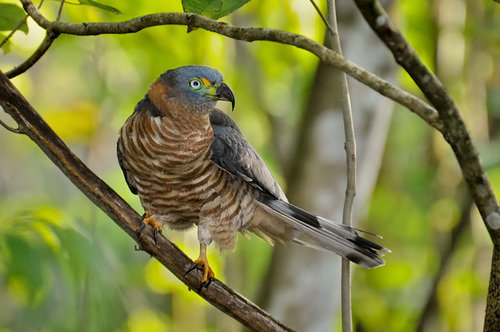
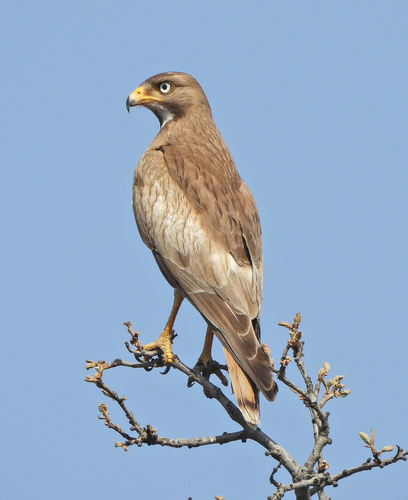
This is a description of the white-eyed buzzard, with the scientific name Butastur teesa (Franklin, 1831). This small, slim hawk can be easily identified by its white iris, white throat, and dark mesial stripe. A white spot is sometimes visible on the back of its head. When perched, the tip of its wing nearly reaches the tip of its tail. It has distinctly yellow ceres, a dark head, and darkly barred undersides to its body. In flight, its narrow wings look rounded with black feather tips, and the wing lining is dark. A pale bar crosses the brown upper wing when the bird is in flight. Its rufous tail is barred, with a darker subterminal band. Young birds have brownish irises, a whitish forehead, and may have a broad supercilium. It can only be confused with the grey-faced buzzard Butastur indicus in overlapping ranges, as adult grey-faced buzzards have a distinctive white supercilium. Fledgelings are reddish brown, which differs from the white down typical of most other raptor chicks. This species is widely distributed across South Asia. It occurs throughout the plains of India, and extends up to 1000 m elevation in the Himalayas. It is resident in Iran, Pakistan, Nepal, Bangladesh, and Myanmar. A possible population of this species has been recorded in the Greater Sundas, Indonesia; this population is widely disjunct, and has whiter unmarked feathers on the thigh "trousers" and vent, so it may represent a new form. The species is absent from Sri Lanka and is probably absent from the Andamans. It is a summer visitor to northeastern Afghanistan. It mainly occurs in plains, but may reach up to 1200 m altitude in the Himalayan foothills. Its typical habitat is dry open forest or cultivated land. While numerous in some areas, its population is declining. A late 1950s survey estimated around 5000 birds in the area around Delhi, covering approximately 50,000 km², for a density of 0.1 birds per square kilometre. This species is usually seen soaring alone in thermals or perched still, though groups of two or three are sometimes observed. It has a mewing call or falling whistle transcribed as pit-weer, which is repeated when pairs soar. It is vocal during the breeding season. It feeds mainly on locusts, grasshoppers, crickets, and other large insects, as well as mice, lizards, and frogs. It may also catch crabs near wetlands, and has been recorded taking larger prey such as the black-naped hare Lepus nigricollis. Its breeding season runs from February to May. It builds a loose platform nest of twigs similar to a crow's nest, sometimes placed in a leafless tree. The usual clutch size is three unspotted white eggs. Both sexes share nest-building and feeding young; only the female incubates eggs, which hatch after around 19 days. Several parasites have been recorded from this species. An endoparasitic platyhelminth species has been described from its liver. The nematode Contracaecum milvi has been found in its liver and stomach, while the acanthocephalans Mediorhynchus gibson and M. fatimae have been described from the guts of specimens collected in Pakistan. Blood-stream protozoa belonging to the genus Atoxoplasma have been isolated from this species. Like most birds, it hosts specialized ectoparasitic bird lice, such as Colpocephalum zerafae, which is also known from other birds of prey. A 2011 study of power lines in Rajasthan found that white-eyed buzzards were the second most common raptor killed by electrocution, after kestrels.