About Busycotypus canaliculatus (Linnaeus, 1758)
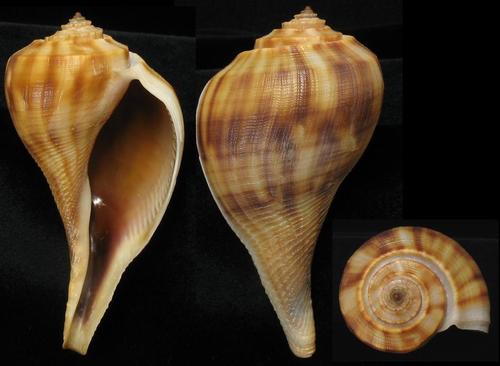
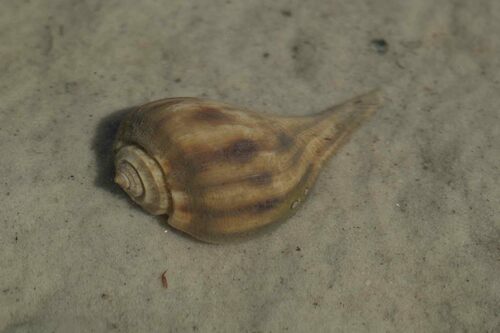
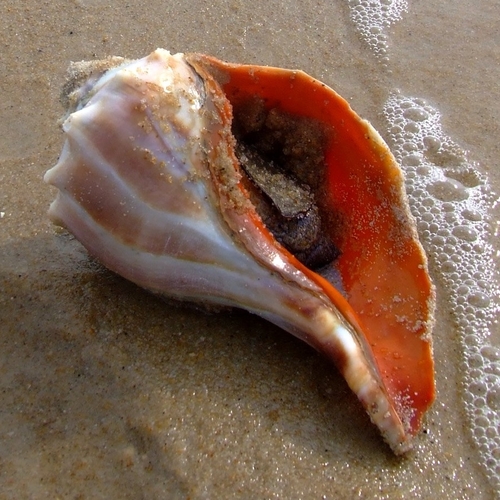
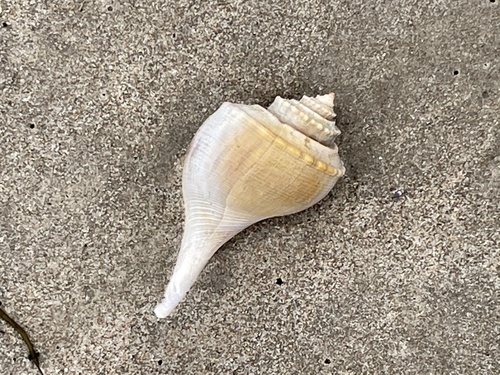
Busycotypus canaliculatus, commonly known as the channeled whelk, has a shell that typically reaches 5 to 8 inches in length. Its shell is smooth and subpyriform, meaning generally pear-shaped, with a large body whorl and a straight siphonal canal. There is a wide, deep channel at the suture between the whorls, and weak knobs are often present on the shoulders of the whorls. Finely sculpted lines start at the siphonal canal and spiral around the entire shell surface. The shell color is typically buff gray to light tan. The shell aperture is located on the right side, so shells of this species are almost always dextral, or right-handed, in coiling; left-handed, or sinistral, specimens are very rare. Channeled whelks prefer sandy, shallow, intertidal or subtidal areas, and they can be common in these habitats. They are generally nocturnal and are known to feed on clams. One of their known predators is the blue crab, Callinectes sapidus. This species is native to the eastern coast of the United States, ranging from Cape Cod, Massachusetts to northern Florida. It has also been introduced into San Francisco Bay. The species is edible. Along with hard clams, Busycotypus canaliculatus is used to make wampum, traditional shell beads created by Eastern Woodlands tribes of Native Americans. White wampum beads are made from the inner spiral, or columella, of the channeled whelk shell of either Busycotypus canaliculatus or Busycotypus carica. Black or purple sewant, also called suckauhock, beads are made from hard clam shells. Before European contact, strings of wampum were used for storytelling, as ceremonial gifts, and to record important treaties and historical events, such as the Two Row Wampum Treaty and Hiawatha belts. Northeastern Indigenous tribes also used wampum as a form of exchange, strung into lengths for convenience.