About Busycon carica (Gmelin, 1791)
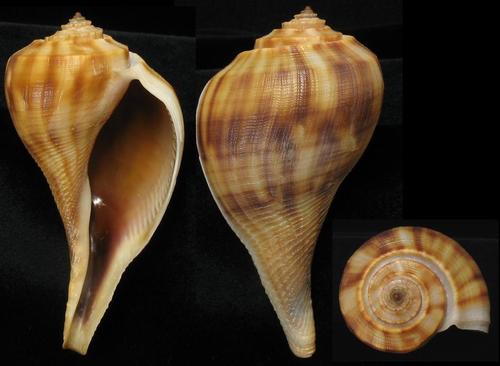
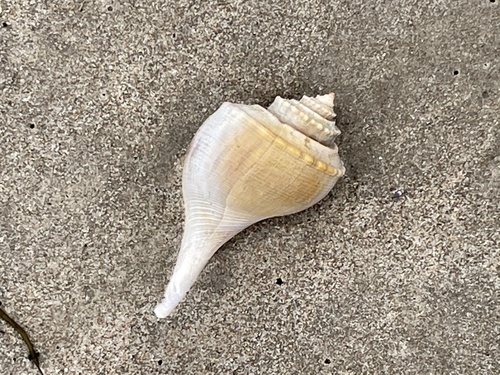
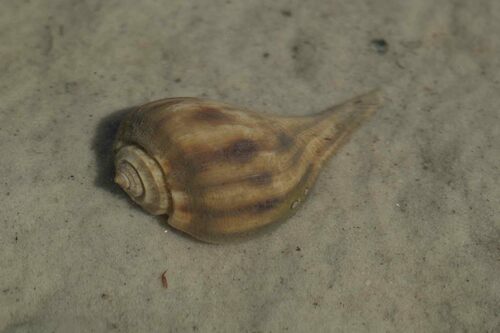
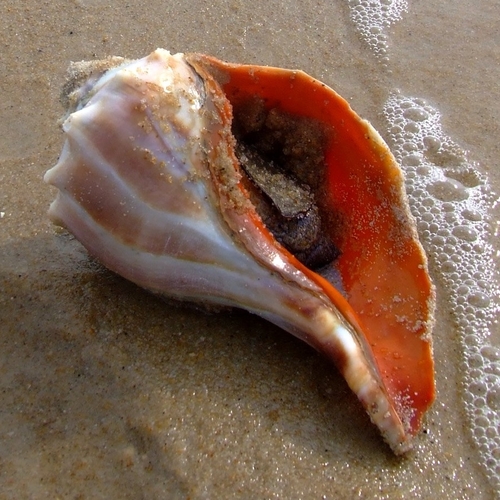
The knobbed whelk, with the scientific name Busycon carica (Gmelin, 1791), most often has a dextral, or right-handed, shell. When you hold the shell with its spiral end pointing upward and its opening facing you, the opening sits on the right side from the animal's perspective. The shell itself is thick and strong, with six clockwise coils. Its surface is marked by fine striations, and a ring of knob-like projections sticks out from the widest part of the coil. The shell's exterior is ivory or pale gray, while the large inside opening, called the aperture, is orange. The internal canal is wide, and the opening can be closed by a hard, horny, oval operculum. Knobbed whelks are native to the North Atlantic coast of North America, ranging from Cape Cod, Massachusetts to northern Florida. The species is common along the Georgia coast, and it is the official state shell of both New Jersey and Georgia. The knobbed whelk is a subtidal, migratory sea snail that alternates between deep and shallow water depending on the season. During the extreme weather of summer and winter, these snails live in deep water, at depths up to 48 meters. During the milder weather of spring and fall, they live in shallow water, on near-shore or intertidal mud flats and sand flats. On shallow-water mud flats, knobbed whelks prey on oysters, clams, and other marine bivalves. They use the edge of their shell to wedge a bivalve open, then insert their long proboscis to eat the victim's flesh. They rasp at the flesh with their radula, a rough tongue-like organ that holds thousands of tiny tooth-like protrusions called denticles. Knobbed whelks are slow-moving predators that hunt by detecting odors, and they have a notable ability to integrate sensory signals over time. This allows them to successfully navigate prey odour plumes even in naturally turbulent aquatic environments. Mating and egg laying take place during the spring and fall migration. After internal fertilization, eggs are surrounded by a transparent gel-like mass of albumen. The eggs are laid inside protective flat, rounded egg capsules that are linked together to form a paper-like chain of egg cases, commonly known as a "Mermaid's Necklace". On average, each capsule holds 0 to 99 eggs, and most full chains have 40 to 160 capsules. After laying their chain of egg cases, the female knobbed whelk buries one end of the chain into the seabed substrate. This anchors the developing fertilized eggs and keeps the chain from washing ashore, where the eggs would dehydrate. Fertilized eggs develop inside the capsules, and young whelks emerge with a shell that is roughly 2 to 4 millimeters in length. Young knobbed whelks are preyed on by crustaceans, horseshoe crabs, and fish, most commonly drum species. Adult whelks are eaten by loggerhead sea turtles. Like conchs, knobbed whelks are used as food by humans, and are prepared in dishes such as raw salads, burgers, fritters, and chowders. Also like conch shells, the knobbed whelk's shell can be turned into a natural bugle by cutting off the tip of the spire to make a mouthpiece. Historically, American Indians used knobbed whelks to make parts of wampum, shell beads that were exchanged for trade across North America.