About Bursatella leachii Blainville, 1817
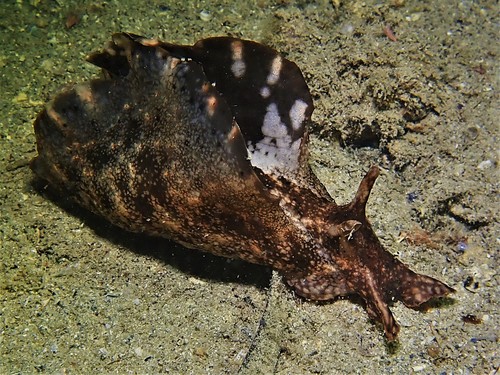
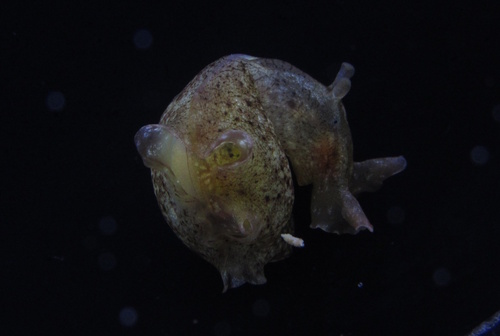
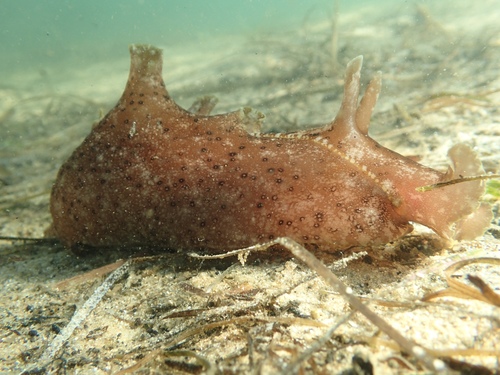
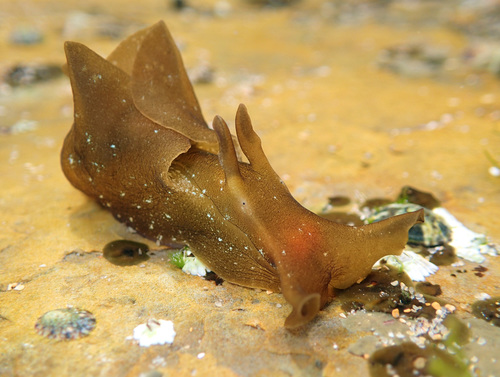
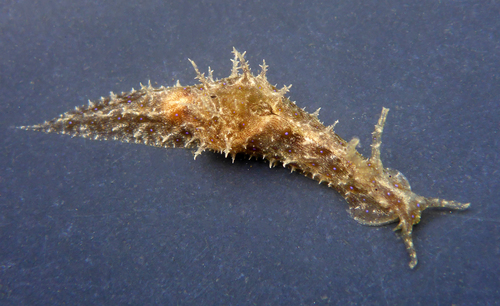
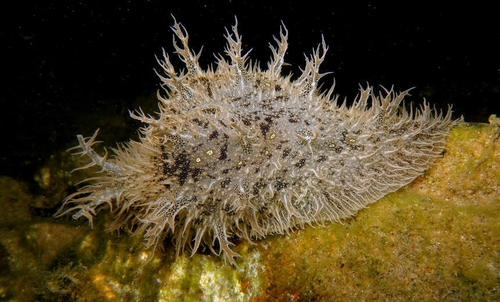
Bursatella leachii Blainville, 1817, ranges in color from green to greenish brown. It has a broad, short head, and its mantle is covered in finger-like outgrowths called papillae, which give the body a thorny appearance. The mantle displays a network-like pattern, with blue ocelli (eyespots) that sit within black spots, alongside green areas. This species moves slowly across a broad foot. It has a short, sharp tail, and its short fleshy, wing-like outgrowths called parapodia are fused at their rear end. The maximum recorded body length of this species is 120 mm. This species has a wider distribution than almost any other heterobranch sea slug. It is found in Atlantic coastal areas down to South Africa, and across parts of the Indo-West Pacific ocean. It occurs across 20,000 km of tropical waters spanning from the Caribbean to Japan, but is not present in the central and eastern Pacific. Researchers have hypothesised that the Agulhas Current around the southern tip of Africa intermittently connects the Atlantic and Indian-Pacific populations of this species, which explains the small genetic sequence divergence observed between these two groups. Bursatella leachii colonised the Mediterranean Sea around the middle of the 20th century. It was first recorded in the 1950s on the Levantine coast and in Italy, and reached Morocco, southern Spain, and France by the 2000s. Because it was first observed in the eastern Mediterranean, it was originally assumed the population originated in the Red Sea via the Suez Canal. However, genetic sequencing found that Mediterranean and Atlantic populations have almost identical haplotypes, which means the species most likely arrived in the Mediterranean from the Atlantic. Unlike many other species that invade the Mediterranean via transport in ship ballast water, B. leachii probably arrived naturally: shifts in sea surface temperatures, which normally block the species from entering the Strait of Gibraltar, have moved north due to climate change, allowing the species to move in. This species is typically found in protected marine bays, estuaries, and tidal pools, and occurs in the intertidal zone down to at least 10 m depth. It is a benthic detritivore that grazes for food on muddy or sandy seabeds. Wild populations have been observed feeding on a range of macroalgae, including the green alga Enteromorpha, as well as the cyanobacteria Calothrix crustacea, and the species can form large populations in response to bacterial blooms. This sea hare may occur alone or in dense concentrations. It follows a consistent daily rhythm: it gathers in groups at sunset and disperses again in the morning. This pattern holds even in captivity; in captive groups, copulation occurs mostly in the morning, while feeding happens in the afternoon. This species lays its eggs in egg ribbons that form long, green, stringy tangles. After hatching, veliger larvae grow quickly and reach full size in 15 days. They are able to metamorphose into their adult form when only 19 days old — this is the shortest larval period ever recorded for sea slugs — but larvae can remain planktonic for up to three months. Larvae undergo metamorphosis on cyanobacteria, a process that takes 1 to 2 days. They discard their shells once they reach a length of 2.5 to 3.0 mm. Adult individuals grow relatively quickly, and reach sexual maturity 2 or 3 months after hatching.