About Bursaria spinosa Cav.
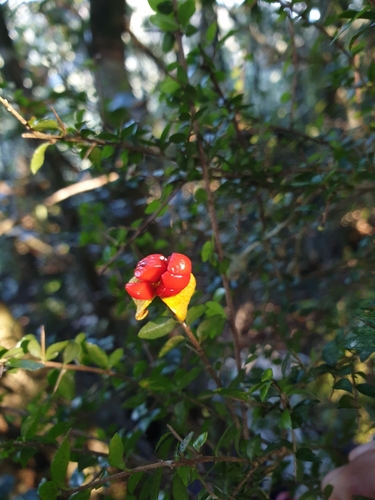
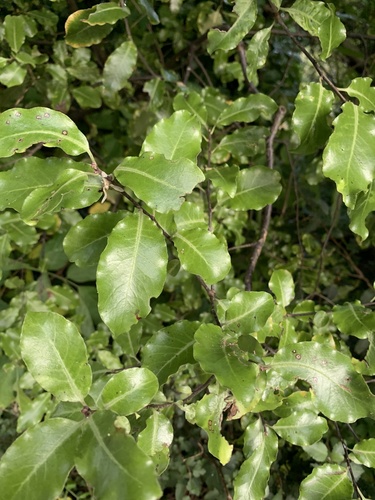
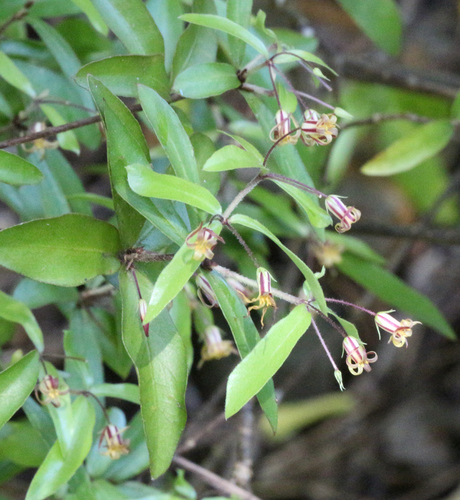
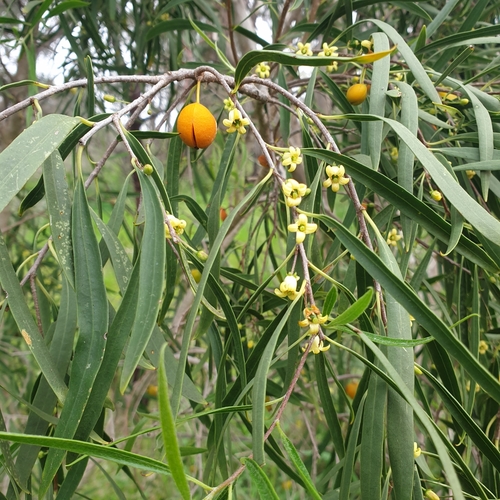
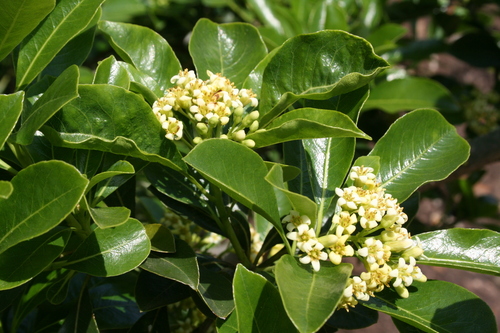
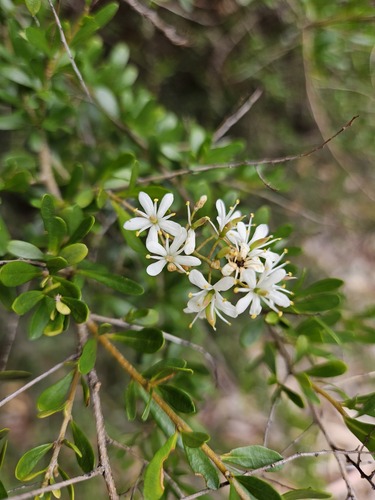
Bursaria spinosa Cav. is a species with a variable growth habit, reaching heights between 1 and 12 meters. It has dark grey, furrowed bark; its smooth branches are sometimes covered in thorns. Leaves are arranged alternately along stems or clustered around nodes, and carry a pine-like fragrance when bruised. Leaf shape ranges from linear to oval or wedge-shaped (ovate, obovate, or cuneate), measuring 2–4.3 cm long and 0.3–1.2 cm wide, with a rounded apex. Its fragrant flowers can bloom at any time of year, but most commonly appear in summer, and grow in leafy, pyramid-shaped panicles.
Bursaria spinosa is widespread and common as an understorey plant in eucalypt woodland across all Australian states except Western Australia and the Northern Territory. In New South Wales, it grows in dry to wet forest across all but the most arid parts of the state, and sometimes grows as a weed on cleared land. In the Sydney region, it grows on clay- and shale-based soils as an understory plant alongside grey box (Eucalyptus moluccana), forest red gum (E. tereticornis), and the grass Themeda australis. It can form thickets on ungrazed farmland. In Victoria, the species is widespread and common across the entire state except the far northwest, heavier soils, and alpine areas. In South Australia, it is widespread in the state’s south-east, and in Tasmania it occurs mainly in dry areas. Subspecies lasiophylla has a more restricted distribution: in New South Wales it is found on the central and south coasts, and the central and southern tablelands, growing in woodland on heavier clay soils than subsp. spinosa. In Victoria, this subspecies grows mainly in dry, rocky locations within forest and shrubland in eastern and central-western areas of the state.
Bursaria spinosa has a lifespan of 25 to 60 years, and can resprout from its woody base after bushfire. It is highly rhizomatous, so entire stands of plants are often genetically a single individual. Even when genetically identical, different plants and even individual shoots can have very distinct appearance, for example spineless shoots that were previously classified as the subspecies "inermis". Its seed is dispersed by wind, and it acts as a colonising plant.
A wide range of insects visit the flowers of Bursaria spinosa, and the most important pollinators appear to be beetles from several families. Common visitors recorded during field work near Armidale include jewel beetle species such as Curis splendens and Stigmodera inflata; longicorn beetles including Amphirhoe sloanei and Tropocalymma dimidiatum; scarab beetles; and tumbling flower beetles. Both beetles and scoliid wasps carried large amounts of pollen, while other visitors such as flies and butterflies carried much lower amounts. Larvae of the jewel beetle species Astraeus crassus live in tunnels inside dead and dying branches. Caterpillars that feed directly on Bursaria spinosa include Proselena annosana, the two-ribbed arctiid (Palaeosia bicosta), and the bark looper moth (Ectropis subtinctaria), while caterpillars of the clouded footman (Anestia ombrophanes) graze on algae and lichens growing on the plant’s branches.
The bright copper butterfly (Paralucia aurifera) and the ant species Anonychomyrma nitidiceps form a complex symbiotic relationship on Bursaria spinosa. Butterflies lay their eggs on the underside of the plant’s leaves, and caterpillars feed on the leaves before pupating in soil at the base of the plant. The ants excavate chambers in the soil where caterpillars sleep and later pupate, and accompany caterpillars while they feed. The ants are thought to feed on secretions produced by the caterpillars. Caterpillars of the fiery copper (Paralucia pyrodiscus) are similarly accompanied by ants of the genus Notoncus, and the endangered Bathurst copper (Paralucia spinifera) breeds and feeds exclusively on subspecies lasiophylla in Central New South Wales. Cattle and rabbits graze on young Bursaria spinosa plants.
The compound aesculin, used in medical research and as an ingredient in 1940s sunscreen, is harvested from this plant in the Sydney region. While its thorns make it unpopular for cultivation, it can be useful as a protective deterrent barrier. It can be grown from fresh seed or cuttings, and is hardy in most growing conditions. Bursaria spinosa provides nectar for butterflies and shelter for small birds.