About Burkea africana Hook.
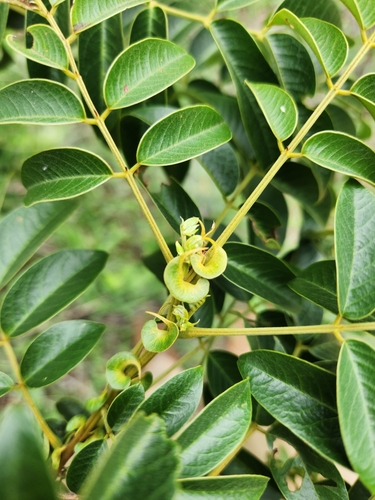
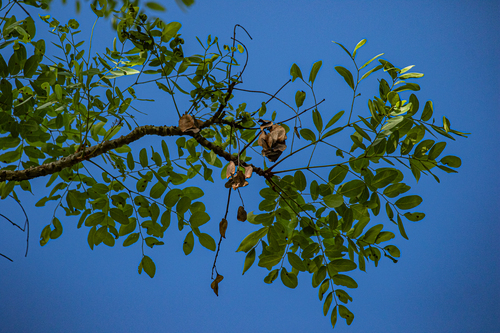
Burkea africana Hook. is a tree that reaches heights between 4 and 20 meters. Its leaves are bipinnately compound, and may be either silvery pubescent or glabrescent. The species produces creamy white, fragrant flowers arranged in pendulous racemes that grow up to 300 mm in length. The bark of Burkea africana is toxic, and contains high levels of alkaloids and tannins. It is used for tanning leather, and pulverized bark from the tree is thrown into water to paralyze fish. This tree is widespread across sub-Saharan Africa, ranging from Senegal east to Sudan and south to South Africa. It has been recorded in Chad, Sudan, Tanzania, Uganda, Cameroon, the Central African Republic, Zaire, Benin, Burkina Faso, Ivory Coast, Ghana, Guinea, Mali, Niger, Nigeria, Senegal, Togo, Angola, Malawi, Mozambique, Zambia, Zimbabwe, Botswana, Namibia, and the Transvaal region of South Africa. It typically grows in deciduous woodland and savanna habitats at elevations between 270 and 1300 meters, and is generally not found in humid tropical rain forests. In its ecosystem, the foliage of Burkea africana is browsed by the larvae of two Saturniidae moth species: Rohaniella pygmaea and Imbrasia forda. Heartwood harvested from Burkea africana produces durable, insect-resistant timber. The timber has a moderately fine, wavy grain and ranges in color from dark brown to reddish brown. It is commonly used for parquet flooring, fine cabinetry, and furniture work.