About Bungarus multicinctus Blyth, 1861
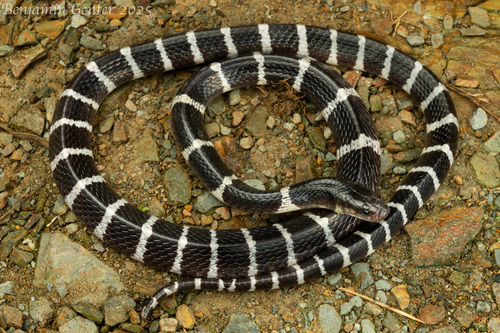
The many-banded krait (Bungarus multicinctus Blyth, 1861) is a medium to large species of snake, with an average length of 1 to 1.5 m (3.5 to 5 ft), and a maximum recorded length of 1.85 m (6.1 ft). Its body is slender and moderately compressed, with smooth, glossy scales and a noticeably distinct vertebral ridge. Its base body color ranges from black to dark bluish-black, with approximately 21 to 30 white or creamy white cross bands along the entire length of its upper body. Longer than average specimens tend to have more cross bands. The tail is short and pointed, it is black with 7 to 11 alternating white cross bands. The belly is usually white, and may also be off-white or creamy white. The head is primarily black, broad and oval in shape, flat and slightly distinct from the neck. The eyes are small and black, with black pupils that are hard to notice because they blend into the rest of the eye. This species has large nostrils. Its fangs are small, fixed, and located at the front of the upper jaw. Juvenile many-banded kraits usually have whitish blotches on the underside of their heads. This species is distributed across Taiwan (including the Matsu and Kinmen Archipelagos), Hong Kong, Myanmar (Burma), Laos, and northern Vietnam, and may also occur in Thailand. In China, kraits with white cross-bands were long assumed to be many-banded kraits; however, a 2017 genetic study found that most museum specimens classified as this species were actually Malayan kraits, and confirmed that true many-banded kraits are restricted to southern China, specifically the provinces of Fujian, Jiangxi, Hubei, Hunan, Hainan, Zhejiang, Guangdong, and Guangxi. The study authors noted that other specimens labeled as many-banded kraits from Vietnam, Thailand, and Myanmar may also be Malayan kraits. While this species can be found at elevations up to around 1,500 m (4,900 ft), it is far more common in humid lowland areas, and is most often observed in the subtropical, marshy regions of its range. It is also frequently found in shrublands, woodlands, agricultural fields, and mangroves, often in areas adjacent to water such as rivers, streams, rice paddies, and ditches. It may sometimes be found in villages and suburban areas, and is able to survive in other habitats as well. Limited information is available on the reproductive habits of the many-banded krait. Like many elapids, many-banded kraits are oviparous. Mating takes place between August and September. Females typically lay 3 to 15 eggs, though clutches as large as 20 eggs have been recorded. Eggs are deposited in late spring or early summer, most often in June. Eggs hatch approximately one and a half months after being laid. Hatchlings measure around 25 centimetres (9.8 in) in length. The oldest recorded many-banded krait was a captive individual that lived to 13.7 years old.