About Bungarus flaviceps Reinhardt, 1843
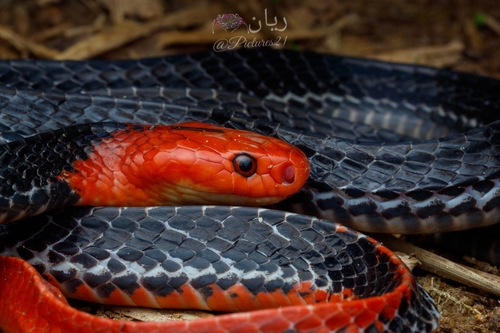
Bungarus flaviceps Reinhardt, 1843, commonly called the red-headed krait, has very striking, distinctive coloration: a bright red head and tail, paired with a black body that bears a narrow bluish-white stripe along its lower lateral edge. Its large, smooth scales give the red-headed krait an overall glossy, attractive appearance. In captivity, individuals generally do not strike unless they have been subjected to prolonged teasing. The average length of this species is 1.2 to 1.5 m (4 to 5 feet), with a maximum recorded length of 2.1 m (7 feet). It has short, hollow fangs attached to its maxillary bones, with inlets at the fang bases and outlets near the fang tips. Venom is channeled into the inlet and forced out through the hole at the fang tip. This species looks similar to two other snakes: the venomous blue Malayan coral snake (Calliophis bivirgata), and the nonvenomous red-headed reed snake (Calamaria schlegeli).
The red-headed krait is distributed across southern Myanmar, Thailand, Cambodia, Vietnam, Peninsular Malaysia, Borneo, Singapore, and multiple islands including the Malaysian Pulau Tioman, and the Indonesian islands of Bangka, Sumatra, Java, and Belitung (also called Billiton). The subspecies B. f. baluensis, sometimes referred to as the Kinabalu krait, is found in Sabah on Borneo. Red-headed kraits live in rainforests in mountainous and hilly areas, and they are almost never found near human settlements.