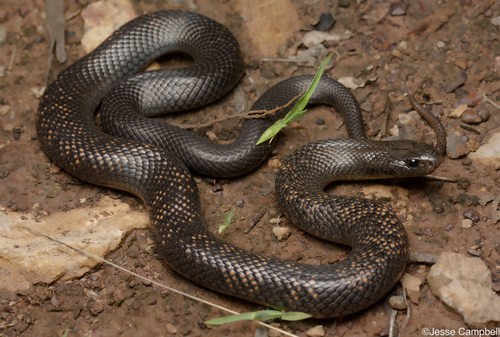
About Bungarus fasciatus (Schneider, 1801)
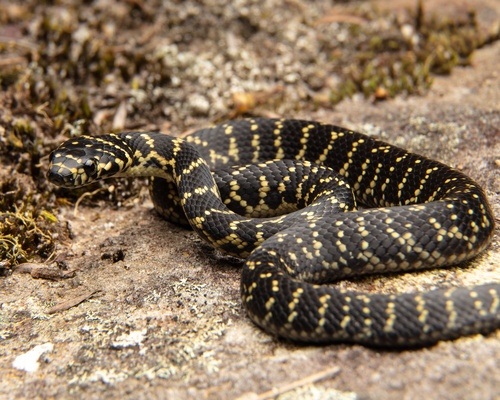
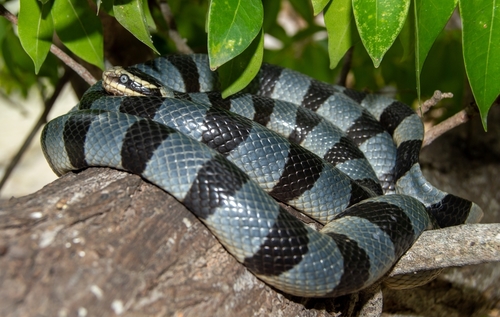
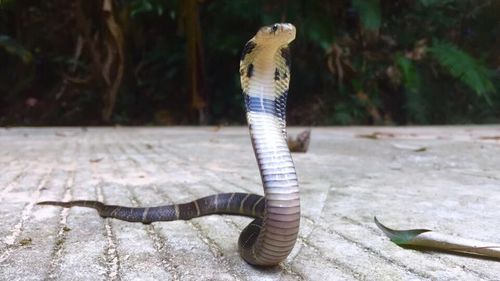
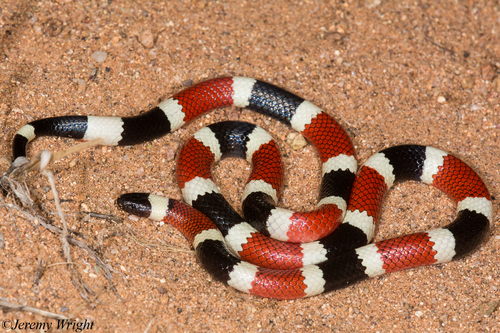
The banded krait, with the scientific name Bungarus fasciatus (Schneider, 1801), can be easily identified by its alternating black and yellow crossbands that fully encircle its body. Its head is broad and flattened, and is not distinctly separated from the neck. The eyes are black, and the otherwise black head has arrowhead-shaped yellow markings. The lips, lores, chin, and throat are also yellow. The tail is relatively small, measuring roughly one-tenth of the snake's total body length. The longest recorded banded krait reached 2.25 m (7 ft 5 in), while individuals encountered typically grow to around 1.8 m (5 ft 11 in). For scalation: the species has 15 dorsal scale rows at midbody; all sub-caudal scutes are undivided, numbering 23 to 39; the middorsal row of vertebral scales is hexagonal, strongly enlarged, and as broad as or broader than it is long; the anal plate is undivided. The tip of the tail is blunt, a distinct vertebral ridge runs down the back formed by the neural processes of the vertebrae, and there are 200 to 234 ventrals. Patrick Russell recorded the name Bungarum Pamah for a specimen from "Mansoor Cottah", and he also received specimens from Bengal. The scientific genus name is derived from bangarum, a term meaning gold in Telugu (and also in Kannada), which refers to the yellow rings around the snake's body. In terms of distribution and habitat, the banded krait is found across the entire Indo-Chinese subregion, the Malay Peninsula, the Indonesian archipelago, and southern China. It is common in the Indian states of West Bengal, Odisha, Mizoram, Assam, Manipur, and Tripura, as well as in Nepal and Bangladesh, and becomes increasingly uncommon the further west it occurs in India. It has been recorded from central India eastward through Nepal, Bangladesh, Myanmar, Cambodia, Thailand, Laos, Vietnam, and southern China (including Hainan and Hong Kong), Malaysia, the main Indonesian islands of Borneo, Java, and Sumatra, and Singapore. In India, recorded locations include Andhra Pradesh, Bihar, Chhattisgarh, Jharkhand, Madhya Pradesh, Maharashtra, Northeast India, Odisha, Tamil Nadu, Kerala, and West Bengal. More recent records of the species come from Hassan District in Karnataka, Chalkari in Bokaro District, Jharkhand, Trivandrum in Kerala, and Amalapadu in Srikakulam District, Andhra Pradesh. Banded kraits can live in a wide range of habitats, from forests to agricultural land. They live in termite mounds and rodent holes near water, and often inhabit areas close to human settlements, especially villages, because these areas provide access to rodents and water. They prefer open countryside plains. In Myanmar, the banded krait has been found at altitudes up to 5,000 feet (1,500 m). For feeding, the banded krait primarily preys on other snakes, but is also known to eat fish, frogs, skinks, and snake eggs. Snake species preyed on by banded kraits include the sunbeam snake (Xenopeltis unicolor), rainbow water snake (Enhydris enhydris), red-tailed pipe snake (Cylindrophis ruffus), chequered keelback (Fowlea piscator), buff-striped keelback (Amphiesma stolatum), rat snake or dhaman (Ptyas mucosus), Indo-Chinese rat snake (Ptyas korros), cat snake (Boiga trigonata), Russell's viper (Daboia russelii), and common krait (Bungarus caeruleus). After the venom renders prey inactive, the prey is swallowed head first.