About Bulbophyllum shepherdii (F.Muell.) Rchb.f.
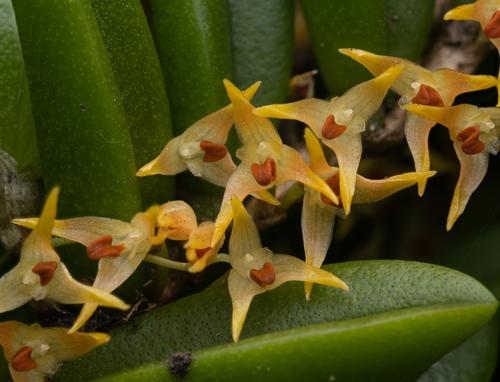
Bulbophyllum shepherdii is an epiphytic or lithophytic herb that has branching rhizomes, which form a dense mat over its growing substrate. Its pseudobulbs are roughly spherical but flattened, measuring 2–3 mm (0.08–0.1 in) in diameter, and are spaced 2–9 mm (0.08–0.4 in) apart from each other. Each pseudobulb produces one grooved, stalkless leaf that is elliptic to egg-shaped, 20–40 mm (0.8–2 in) long and 6–8 mm (0.24–0.31 in) wide, with a channelled upper surface. A single white or cream-coloured flower with yellow tips is borne on a 5–9 mm (0.2–0.4 in) long flowering stem; the flower is 4–5 mm (0.16–0.20 in) long and 2–3 mm (0.079–0.12 in) wide, and does not open widely. The sepals and petals are fleshy: sepals are 4–5 mm (0.16–0.20 in) long and about 2 mm (0.08 in) wide, while petals are about 2 mm (0.08 in) long and 1.5 mm (0.06 in) wide. The labellum is reddish brown, about 2 mm (0.08 in) long and 1 mm (0.04 in) wide, with smooth edges and a sharp bend near its middle. Flowering of this species occurs from March to August. Bulbophyllum shepherdii grows on trees and rocks in rainforest and wet forest, in the range between Nambour in Queensland and Bega in New South Wales.