About Bulbine bulbosa (R.Br.) Haw.
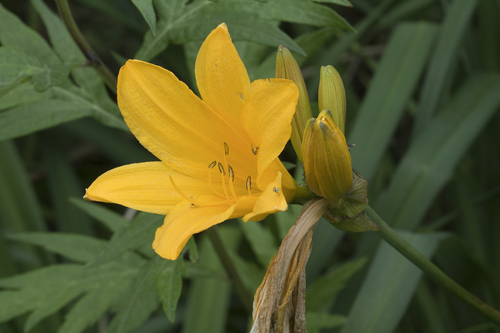
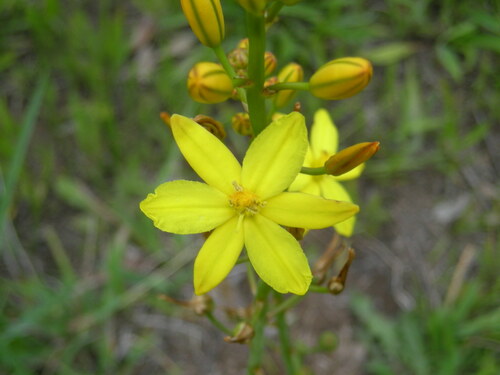
Bulbine bulbosa (R.Br.) Haw. is a perennial tufted herb, growing 27 to 75 cm (11 to 30 in) tall. It has thick, fleshy roots and usually forms a bulb-like tuber. Each plant produces 3 to 7 leaves; the leaves are channelled to more or less cylindrical, tapering, hollow, and grow up to 30 cm (12 in) long, between 1 and 5 mm (0.039 to 0.197 in) wide. Flowers are arranged in racemes 4.5 to 26 cm (1.8 to 10.2 in) long, with up to 50 fragrant flowers held on one or two scapes 19 to 50 cm (7.5 to 19.7 in) long. Each individual flower sits on a pedicel 5 to 30 mm (0.20 to 1.18 in) long, with a 0.7 to 15 mm (0.028 to 0.591 in) long bract at the pedicel base. This species has six yellow tepals that measure 9 to 22 mm (0.35 to 0.87 in) long and 1 to 3.5 mm (0.039 to 0.138 in) wide. Stamens are 8 to 9 mm (0.31 to 0.35 in) long, with golden-brown club-shaped hairs on their filaments and gold-coloured anthers. Flowering occurs between February and March, and the fruit is a more or less spherical to oval capsule 3 to 6 mm (0.12 to 0.24 in) long. This species occurs in all Australian states and the Australian Capital Territory, excluding Western Australia and the Northern Territory. It grows in a wide range of habitats, most commonly in damp areas of grassland, woodland and forest, and sometimes grows at altitudes above 1,800 m (5,900 ft). Experiments conducted for habitat reconstruction programs in south-eastern Australia have found that the germination success of self-sown B. bulbosa seeds between grass tufts depends on both the grass species and the width of the gap between grass tufts. This plant is reported to cause scouring if eaten by sheep or cattle. The corms of mature B. bulbosa are nutritious, containing calcium and iron, and were traditionally used as food by Aboriginal people, who know this plant by the names parm, puewan, and pike. Aboriginal people considered the corms the sweetest-tasting of all Australian lily and lily-like plants. In horticulture, the long-lasting scapes of fragrant, attractive yellow flowers and moderate frost-hardiness of this species have led to its use as a garden flower in suitable climates, though few cultivated garden varieties have been developed. It can be propagated from seed or by dividing corms. Seeds are released from ripened seed capsules, and are best stored for at least one to two months before sowing. Sowing should be done in spring, and germination takes approximately 35 days. Good watering and drainage are required for cultivation. This species suppresses self-fertilization, so seeds collected from garden-grown plants often have low germination rates; planting seeds collected from multiple different sources can improve seed yield.