About Bugula neritina (Linnaeus, 1758)
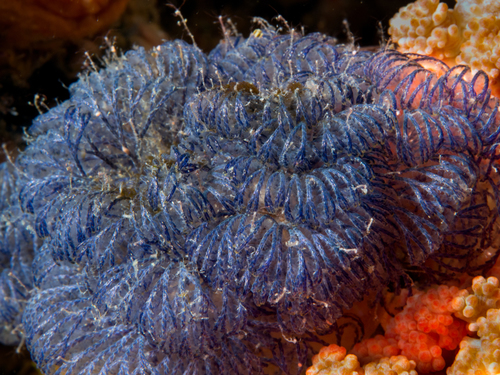
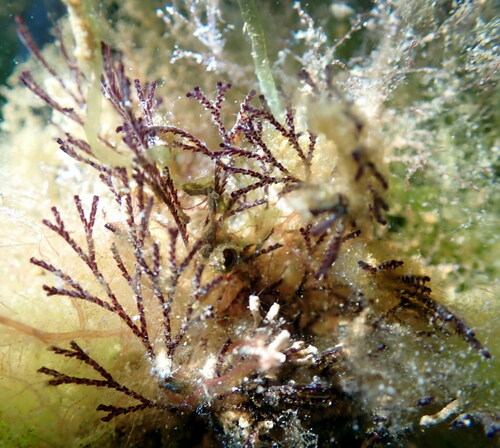
Bugula neritina forms brown-purplish fouling colonies. It is a sessile suspension feeder that consumes particles suspended in water. The individual zooids that make up the colony are white, each with a pointed exterior corner. This species differs from other species in the genus Bugula because it lacks avicularia and spine zooids. Colonies are perennial, living more than one year. All zooids are hermaphrodites, and gametes are released at different times in an individual’s life to prevent self-fertilization. In its life cycle, a single zooid is produced by sexual reproduction, and the full colony develops through budding. Larvae are lecithotrophic, and larval settlement can occur year-round except for mid-winter. This species is a marine colonial bryozoan, one of the first bryozoans to be discovered, and is the type species of the genus Bugula. It has a very wide geographic distribution, and is currently considered to be a complex of three cryptic species that are identical in morphology but differ slightly genetically; the S1 haplotype is the most widely distributed. It is nearly cosmopolitan, found across almost the entire globe, excluding the north and south poles, the subarctic, and the subantarctic. It is common in coastal regions of the North Pacific and North Atlantic, and is also present in Australia, New Zealand, the United States, Hawaii, the Mediterranean Sea, and Brazil. In many regions it is classified as an invasive species. It prefers shallow warm waters with temperatures between 10 and 30 °C. It is often found in port areas and on ship hulls, which has facilitated its dispersal and introduction into new regions. Its biofouling colonies reach approximately 10 centimeters in height, and it prefers to grow on organic, rigid substrates.