About Buglossidium luteum (Risso, 1810)
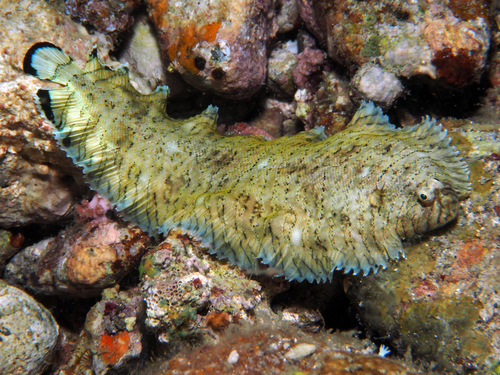
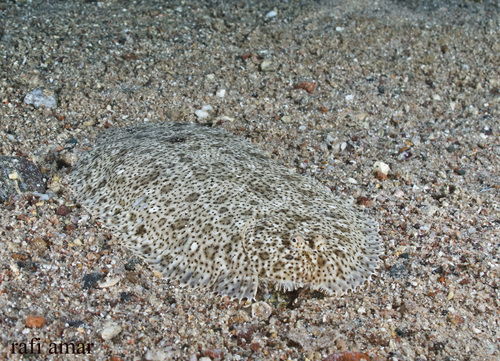
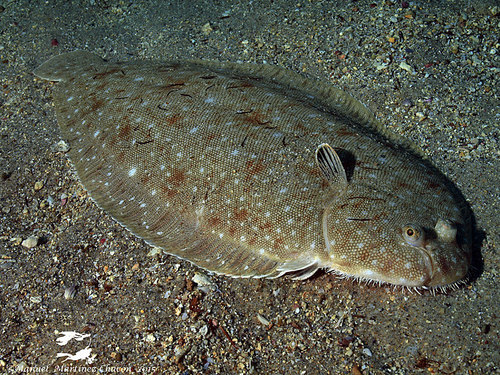
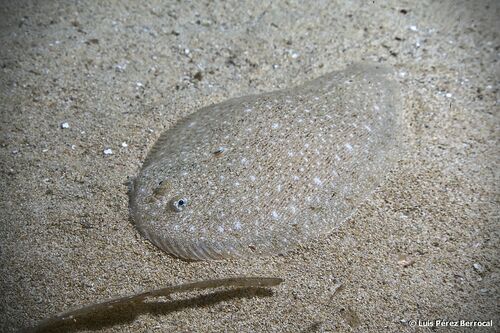
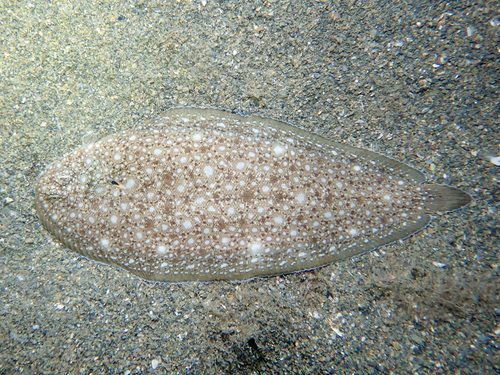
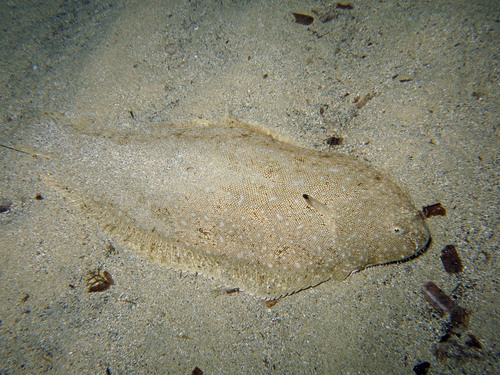
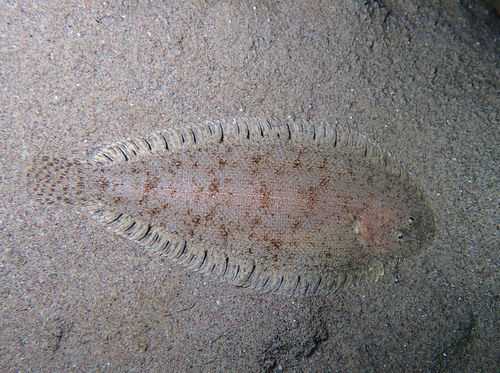
Buglossidium luteum, commonly called the solenette, is the smallest flatfish of the sole family found in European waters. Mature individuals typically measure 10–13 cm (3.9–5.1 in) long, and reach a maximum total length of 15 cm (5.9 in). This species has an oval, compressed, slightly elongated body, with both eyes positioned on the right side of its head. Its snout is rounded, and the upper jaw is slightly elongated to form a small beak. The diameter of the upper eye is smaller than the distance between this eye and the front of the head. Its dorsal fin starts on the anterior profile of the head and has 65 to 78 fin rays. The anal fin holds 49 to 63 fin rays, and a small membrane connects the caudal fin to both the dorsal and anal fins. The pectoral fin on the eyed (right) side is small, with 3 to 5 fin rays, while the pectoral fin on the blind (left) side is reduced, consisting of 1 long fin ray and 1 to 2 short fin rays. The lateral line has 55 to 70 rectangular scales, marked with short, strongly curved intercanalicular striae. The color of the eyed side is variable, most often yellowish or light brown, and may or may not have darker blotches or spots. The dorsal and anal fins are a sandy color, with every 5th or 6th fin ray, or occasionally the 4th or 7th, darkened along most of its length. The solenette can change its body color to better camouflage against its surrounding background. This species occurs in the northeastern Atlantic Ocean, ranging from Iceland and Scotland southward, and is also present in the North Sea, Kattegat, and Baltic Sea. It also lives throughout the Mediterranean Sea, including the Adriatic Sea, Sea of Marmara, and Bosphorus. It has been recorded across a depth range of 5 to 450 m (16–1,476 ft), but is rare in very shallow waters. The highest population densities are found at 5–15 m (16–49 ft) deep in the English Channel, and at 20–35 m (66–115 ft) deep in the Bay of Biscay. Unlike some other flatfish species, the solenette’s distribution is not limited by sediment type. In the Solway Firth, this species generally moves further offshore during the winter. It has more specific habitat requirements than other widespread Atlantic flatfish such as the European plaice, common sole, and common dab. It is concentrated in waters moderately affected by estuary outflows, where salinity ranges from 29 to 33 ppt, and is entirely absent from the mouths of the largest estuaries where salinity is lower. The solenette is most often found on or half-buried in muddy or muddy-sandy substrates. Adult solenette feed on a range of small benthic organisms, with main prey items including crustaceans such as copepods, amphipods, and cumaceans, bivalve molluscs, and polychaete worms. The species’ diet varies by geographic region: solenette living in the English Channel eat a wider variety of prey than those from the Bay of Biscay, and eat proportionally more polychaetes, while Bay of Biscay solenette eat proportionally more crustaceans and molluscs. Feeding activity peaks in summer and drops sharply in winter. Spawning occurs in February in the Mediterranean, from March to June in the Bay of Biscay, and in July and August in the western English Channel, North Sea, and western Ireland. The species’ eggs are small, and can be distinguished from the eggs of other soles by having only a few large oil globules. Larvae hatch at approximately 2 mm long, begin metamorphosis at around 7 mm long, and complete metamorphosis once they reach 8–9 mm long. Larval solenette are similar in appearance to larval common sole, but have fewer large stellate chromatophores. They also have a distinct patch of pigment on the ventral abdominal wall, and their characteristic head shape is visible from early developmental stages. In the North Sea, the species has no dedicated nursery areas, and juveniles and adults live in the same areas. Young solenette begin a benthic (bottom-dwelling) lifestyle once they reach 12 mm long. Most of the species’ growth happens during the first year of life, after which growth continues at a relatively low, constant rate. Both sexes reach sexual maturity in their third year of life. Males grow faster than females, while females reach a larger final adult size. The maximum reported age for the solenette is 13 years.