About Bufo japonicus Temminck & Schlegel, 1838
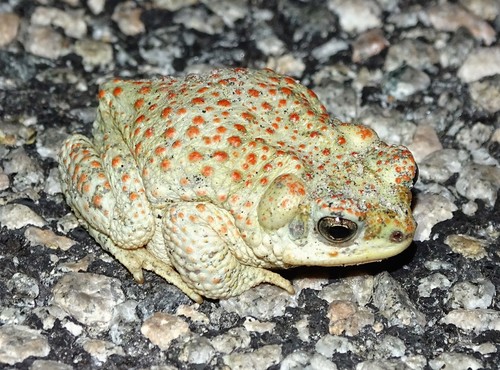
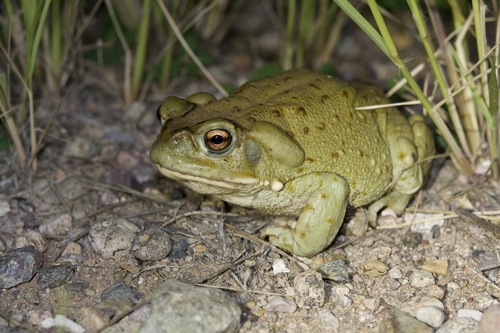
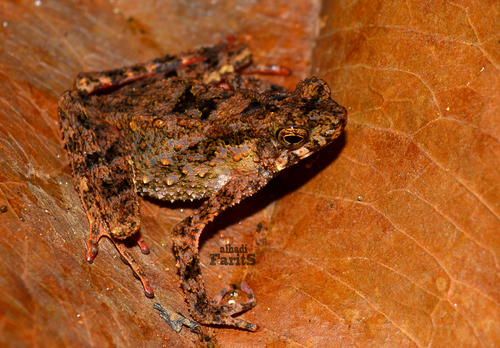
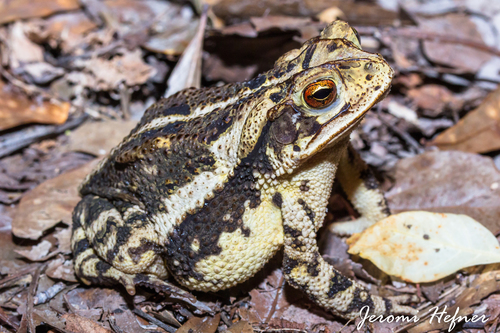
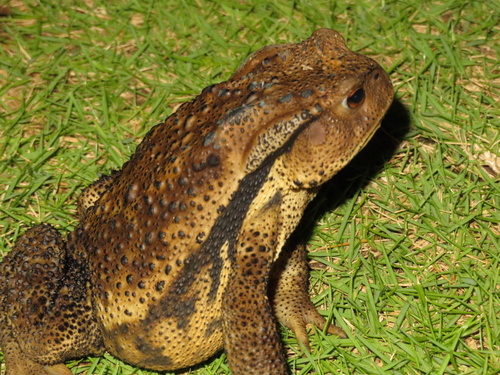
The Japanese common toad, scientific name Bufo japonicus Temminck & Schlegel, 1838, can reach a snout–to–vent length of up to approximately 17.5 cm (7 in). Females are slightly larger than males, and individuals living in warmer habitats grow larger than those in colder areas. Its head is roughly triangular with a pointed snout. The tympanum is elliptical, positioned behind the eye at a distance roughly equal to the tympanum’s longest diameter. The toad has a robust body; its stout forelimbs are about half as long as its hind limbs. On the hand, the second finger is the shortest and the third is the longest. On the hind foot, the first toe is the shortest and the fourth is the longest, with very little webbing between the toes. The skin has small warty outgrowths, and its overall colouring is variable, ranging from greenish-brown and yellowish-brown to darker brown. The skin is often paler and smoother during the breeding season. This toad is native to Japan, where it occurs naturally on the islands of Honshu, Kyushu, and Shikoku. It has also been introduced to Hokkaido and Sado Island. It occupies a wide variety of habitat types, including both lowland and mountainous areas. The Japanese common toad engages in explosive breeding, a pattern tied to its intense male-male competition. While the species’ full mating patterns are not fully conclusive, the primary pattern is polyandry via amplexus. Courtship, which occurs before mating, relies on tactile and visual cues. Amplexus, where the male clasps the female, stimulates increased production of luteinizing hormone in males, triggering sperm release. Male size plays a key role in determining which competitor successfully pairs with a female: larger males can always replace smaller males during amplexus, and female preferences favour fertilization by larger males. This process is called size-assortative mating, which results in a male-biased operational sex ratio and strongly intensifies male-male competition. Both population density and operational sex ratio influence how males compete for female mating partners. When the male population is high in a given breeding area, females have no alternative but to engage in polyandry. Migration to breeding ponds is an important life stage for this species, and this process is tracked by changing production levels of oscillatory potential changes (OSC). OSC levels reach their peak during the breeding month, when the toads have arrived at their breeding destinations. Levels of other hormones, including luteinizing hormone and follicle-stimulating hormone, also increase sharply once the toads reach the breeding site. Overall, the four key processes that occur during the breeding season are: emerging from hibernation, migration, amplexus, and either ovulation in females or spermiation in males.