About Buellia griseovirens (Turner & Borrer ex Sm.) Almb.
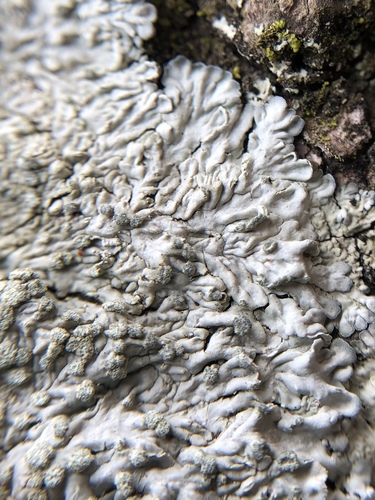
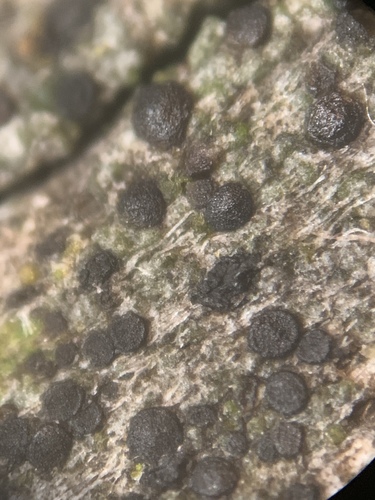
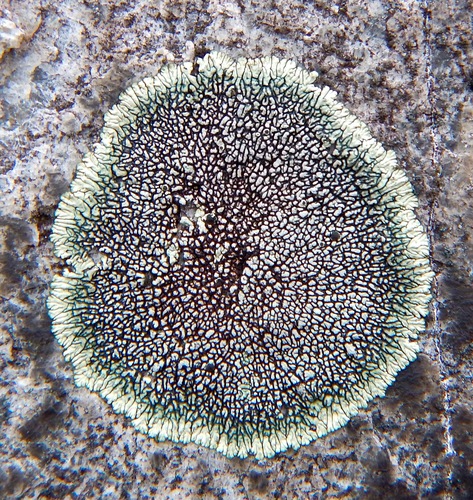
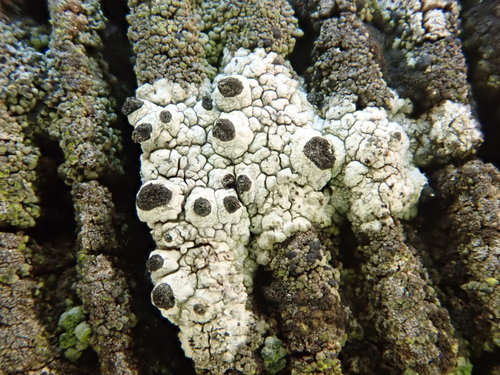
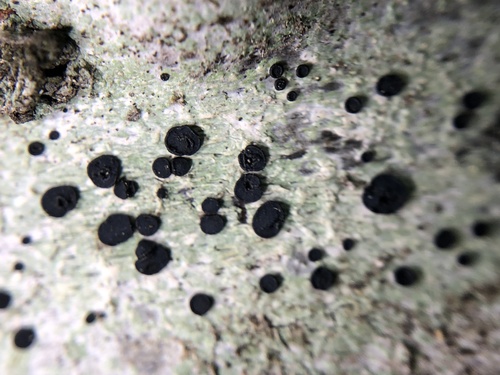
The thallus of Buellia griseovirens ranges from immersed to thick, and is most often pale grey with a black prothallus. Thalli may be continuous or underdeveloped, and sometimes develop minute cracks. This lichen produces scattered, crowded, or confluent grey-green soralia. Soralia are numerous, rarely confluent, and often form a mosaic up to 2 mm in diameter. The soredia are minute with a powdery texture, measuring less than 0.01 mm in diameter. Freshly collected soredia are greenish-grey, fading to a pale yellowish-grey when stored and aged. Soredia are usually enclosed within circular, flat or slightly convex soralia. Apothecia are very rare. Spores range from irregularly 3-septate to sub-muriform. Young apothecia are sessile (attached directly to the substrate), flat, and have a distinct raised margin. As apothecia mature, they become convex, lose their margin, and blend seamlessly into the surrounding surface. The epithecium is dark brown. The colorless hymenium is 110-120 μm tall. The hypothecium is dark brown. Clavate asci measure 110 × 15 μm. Ascospores are pseudomuriform and ellipsoid, and measure (13-)15-28 × 7-13 μm. Buellia griseovirens is distributed across Europe, Mediterranean Africa, the Middle East, and North America. In North America, it occurs in montane areas of southern California (Riverside and Los Angeles Counties), the Canadian provinces and territories of Alberta, British Columbia, Nova Scotia, Ontario, and Yukon, and the U.S. states of Montana and Wyoming. It is also found in New Zealand.