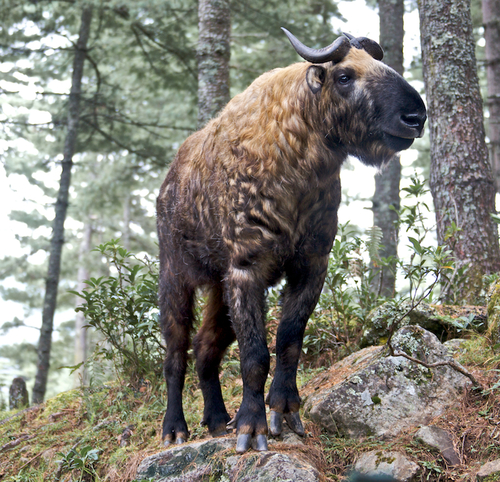
About Budorcas taxicolor tibetana Milne-Edwards, 1874
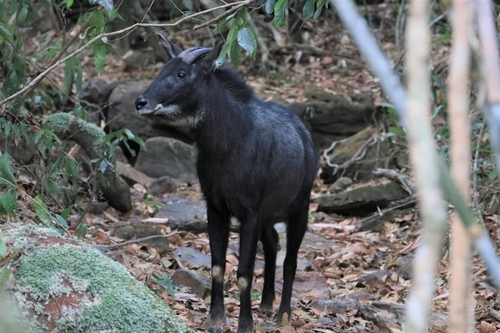
The takin (scientific name Budorcas taxicolor) is a large ungulate species belonging to the subfamily Caprinae, native to the eastern Himalayas. There are four recognized subspecies of takin: the Mishmi takin (B. t. taxicolor), the golden takin (B. t. bedfordi), the Tibetan (or Sichuan) takin (B. t. tibetana), and the Bhutan takin (B. t. whitei). While takins were historically classified alongside muskoxen in the tribe Ovibovini, more recent mitochondrial research reveals they have a closer relationship to Ovis (sheep). Their physical resemblance to the muskox is therefore an example of convergent evolution. The takin is the national animal of Bhutan. Takin occupy habitats ranging from forested valleys to rocky, grass-covered alpine zones, found at altitudes between 1,000 and 4,500 m (3,300 and 14,800 ft) above sea level. The Mishmi takin occurs in eastern Arunachal Pradesh, while the Bhutan takin lives in western Arunachal Pradesh and Bhutan. The Dihang-Dibang Biosphere Reserve in Arunachal Pradesh, India, is a stronghold for Mishmi, Upper Siang (Kopu) and Bhutan takins. Takin typically form small family groups of around 20 individuals, though older males may live more solitary lives. In the summer, herds of up to 300 individuals gather together on high mountain slopes. Groups reach their largest sizes near favourable feeding sites, salt licks, or hot springs. Mating takes place in July and August. Adult males compete for dominance by sparring head-to-head with opponents, and both sexes use the scent of their own urine to indicate dominance. A single young is born after a gestation period of around eight months. In winter, takin migrate from upper pastures to lower, more forested areas, and they favour sunny spots at sunrise. When disturbed, individual takin give a 'cough' alarm call, and the whole herd retreats into thick bamboo thickets and lies on the ground for camouflage. Takin feed in the early morning and late afternoon, grazing on a variety of leaves and grasses, as well as bamboo shoots and flowers. They have been observed standing on their hind legs to feed on leaves over 3.1 m (10 ft) high. Salt is also an important part of their diet, and groups may stay at mineral deposits for several days.