About Buddleja globosa Hope
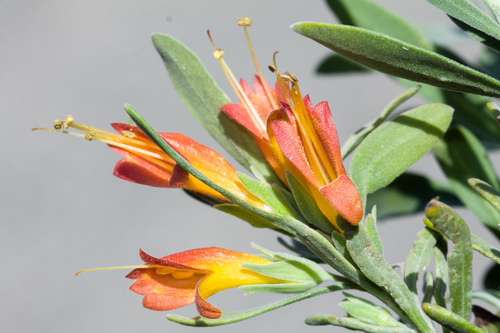
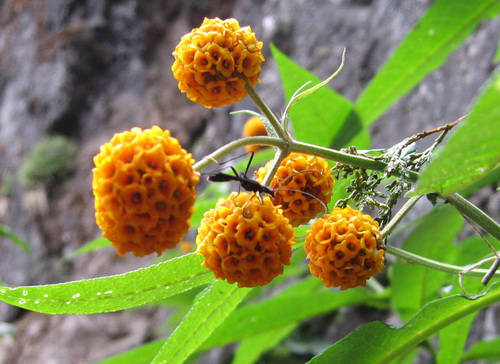
Buddleja globosa Hope is a large shrub that grows up to 5 m (16 ft) tall, with grey fissured bark. Its young branches are subquadrangular and covered in dense short hairs (tomentose). The leaves are sessile or nearly sessile, shaped lanceolate or elliptic, and measure 5–15 cm long by 2–6 cm wide; the upper leaf surface becomes hairless over time and is textured and bumpy (bullate), while the lower surface remains tomentose. The inflorescences are deep yellow to orange, with leaf-like bracts, and consist of one terminal globose flower head plus fewer than 7 pairs of stalked globose heads. Each head is 1.2–2.8 cm in diameter, holds 30–50 individual flowers, and has a strong honey fragrance. The ploidy of this species is 2n = 38, making it diploid. Like many New World species previously placed in Buddlejaceae, B. globosa is cryptically dioecious: while its flowers appear to be hermaphrodite with both male and female structures, only anthers or only pistils are functional on any single individual plant. B. globosa was first introduced to the United Kingdom from Chile in 1774, and is now commonly grown as an ornamental and landscape shrub in temperate regions. Unlike B. davidii, which was introduced more than a century later, B. globosa is not invasive because its seeds do not have wings. It is hardy to USDA zones 5–9, and rated H5 by the Royal Horticultural Society (RHS). The plant was awarded the Royal Horticultural Society's Award of Garden Merit, under record number 687, in 1993. In folk medicine, B. globosa is attributed with wound healing properties. An infusion of its leaves is used topically to treat wounds, burns, and external and internal ulcers. Chemical studies of this species have led to the isolation of glycosidic flavonoids, phenylethanoids (including verbascoside), iridoids, triterpenoids, and sesquiterpenoids.