About Bucorvus leadbeateri (Vigors, 1825)
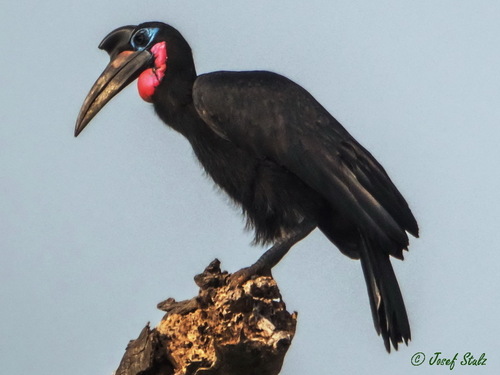
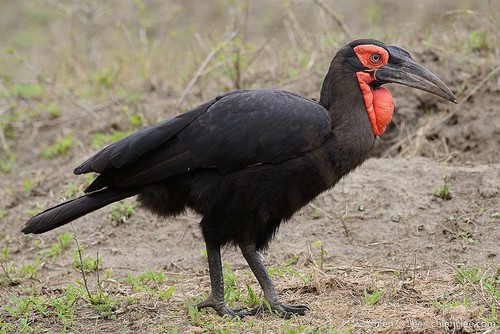
This species, the southern ground hornbill with scientific name Bucorvus leadbeateri (Vigors, 1825), is a very large bird. Individuals measure 90 to 129 cm (2 ft 11 in to 4 ft 3 in) in total length. Females weigh between 2.2 and 4.6 kilograms (4.9 to 10.1 lb), while larger males weigh 3.5 to 6.2 kilograms (7.7 to 13.7 lb). The average weight of eight sampled females was 3.34 kg (7.4 lb), and the average weight of eight sampled males was 4.2 kg (9.3 lb). On average, these birds are around 35% heavier than any Asian hornbill species. Their wingspan ranges from 1.2 to 1.8 m (3 ft 11 in to 5 ft 11 in). Additional detailed measurements are: wing chord 49.5 to 61.8 cm (19.5 to 24.3 in), tail 29 to 36 cm (11 to 14 in), tarsus 13 to 15.5 cm (5.1 to 6.1 in), and culmen 16.8 to 22.1 cm (6.6 to 8.7 in). Stevenson and Fanshawe report that the related Abyssinian ground hornbill is larger on average, with an average length of 110 cm (43 in) compared to this southern species' average of 102 cm (40 in). However, published maximum weights and standard measurements show the southern species is slightly larger, and average weights for the Abyssinian species have not been recorded. Southern ground hornbills have primarily black plumage, with bright red patches of bare skin on the face and throat; juvenile birds have yellow bare skin in these areas instead. This species is one of the few birds that have eyelashes, which are thought to keep dust out of the birds' eyes while they forage during the dry season. A clear identifying trait is the white tips on the primary flight feathers, which are visible when the bird is in flight. The beak is black, slightly curved, and bears a casque that is more developed in males. Females are smaller than males, and have violet-blue skin on their throats. Juveniles under six years old do not have the prominent red throat pouch, and have a duller grey patch in its place. Southern ground hornbills have a distribution ranging from northern Namibia and Angola to northern South Africa, and from southern Zimbabwe to Burundi and Kenya. They require savanna habitat that contains large trees for nesting, and dense short grass for foraging. This species is classified as vulnerable, and is now mainly restricted to national reserves and national parks. They live in groups of 5 to 10 individuals made up of adults and juveniles, and neighboring groups often engage in aerial pursuits of one another. As apex predators, they are ecologically important. They forage on the ground, feeding on reptiles, frogs, snails, insects, and mammals up to the size of hares. They rarely drink. Their range is limited at its western end by a lack of suitable trees to build nests in. Groups of southern ground hornbills are highly vocal. They make contact via group chorus calls that can typically be heard from distances of up to 3 kilometres (1.86 mi). These calls allow each group to maintain its territory, which can be as large as 100 square kilometres (40 sq mi) even in the highest quality habitat. The southern ground hornbill is an obligate cooperative breeder: every breeding pair is always assisted by at least two other birds. Captive experiments have found that birds that do not gain six years of experience as nest helpers cannot breed successfully even when they become breeding adults. This indicates that unaided pairs cannot rear young, and that the skills gained from helping as a juvenile are essential for successfully rearing young as an adult. In captivity, the maximum recorded lifespan for this species is 70 years. It is generally thought that the life expectancy of a bird that survives to fledge is as high as 30 years or more, which is comparable to the lifespan of famously long-lived birds such as the wandering albatross. Southern ground hornbills are believed to reach maturity at six to seven years old, but very few individuals begin breeding at this age. Nests are almost always deep hollows in very old trees, though there are recorded cases of ground hornbills occasionally nesting on rock faces. One to three eggs are laid at the start of the wet season, but siblicide ensures only one nestling ever fledges. The eggs measure 73 millimetres (2.87 in) by 56 millimetres (2.20 in), are pure white in color, and have a very rough texture. After a 40 to 45-day incubation period and an 85-day fledging period, young birds remain dependent on their parents and helpers for between one and two years, depending on climatic conditions. This dependence period is longer than that of any other bird species. As a result, southern ground hornbills can normally only breed successfully every third year. Triennial breeding is rare in birds; the only other well-documented example is the ornate hawk-eagle of Neotropical rainforests.