About Buckleya distichophylla (Nutt.) Torr.
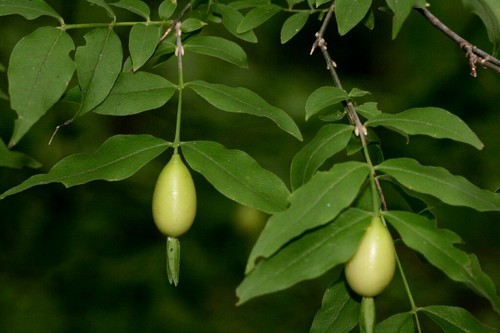
Buckleya distichophylla, commonly known as piratebush, is a flowering plant in the Santalaceae family, native to the Southern United States. It is a rare species that only grows in scattered mountainous areas of North Carolina, Tennessee, and Virginia. This deciduous shrub can reach a maximum height of 15 feet (4.6 meters). Its leaves grow between 2 and 4 inches (5.1 to 10.2 cm) long, and the plant requires direct sunlight to grow. Its flowers measure 1 inch (2.5 cm) long, and have four long, narrow yellow-green bracts. Piratebush has a distinctive survival strategy. Its pale green leaves contain less chlorophyll than most other plants, so it cannot survive on photosynthesis alone. In addition to producing its own energy via photosynthesis, piratebush obtains extra nutrients by parasitizing other plant species. It is classified as hemiparasitic: it attaches to the root systems of other plants using specialized structures called haustoria, and draws nutrients through these attachments. Though scientists originally believed it only attached to hemlock trees, it has since been confirmed that piratebush can parasitize many different species. Currently, piratebush has only been recorded in the mountainous regions of North Carolina, Tennessee, and Virginia. The largest concentration of the species grows within Poor Mountain Natural Area Preserve, located atop Poor Mountain roughly 2 miles (3.2 km) southwest of Roanoke in Roanoke County, Virginia. The total number of piratebush plants growing on Poor Mountain is greater than the total count at all other known sites combined. Even though many other areas of the Appalachians have habitats that appear suitable to support piratebush, researchers still do not know why the species occurs in such a limited number of locations. Thomas Nuttall first discovered and formally described this plant in 1818 along the French Broad River near Paint Rock in Western North Carolina, placing it as a member of the genus Borya in the olive family. It was rediscovered in 1843 by Samuel Buckley, and John Torrey reclassified it into the new genus Buckleya, giving it the scientific name Buckleya distichophylla.