About Buceros hydrocorax Linnaeus, 1766
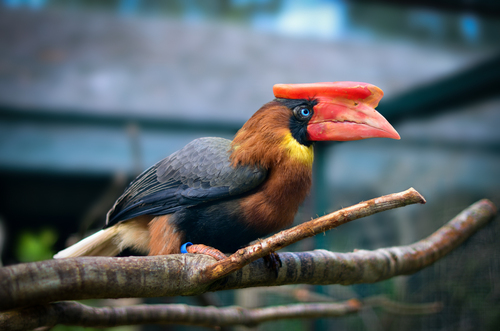
Buceros hydrocorax, first described by Linnaeus in 1766, is a large hornbill bird endemic to the Philippines. It inhabits primary, mature secondary, and disturbed forests, and occurs across most of the country, with the exception of the Mimaropa, Sulu, and Western Visayas regions. This species has a dark body, with rufous legs, chest, and neck, an off-white tail, a black face, and a yellow throat. The nominate subspecies has an entirely red bill, while the subspecies semigaleatus and mindanensis have pale yellow coloring on the distal half of the bill. Buceros hydrocorax is sexually dimorphic: females have striking electric blue eyes, a smaller casque, and no eye ring, while males have yellow eyes and a larger casque. The species' characteristic red bill color comes from the oxidation of oils produced by the uropygial gland. This species occurs mainly in primary evergreen dipterocarp forests, but also uses secondary forest habitat. The northern form of this rufous hornbill has been recorded at elevations up to 760 meters on Luzon, while the southern form has been recorded up to 2,100 meters above sea level on Mt. Apo. The species as a whole is classified as Vulnerable. The northern rufous hornbill is considered more threatened: it is classified as Endangered on the Philippines' National List of Threatened Terrestrial Fauna, while the southern species or subspecies is classified as Vulnerable. This species faces substantial hunting pressure and widespread habitat loss caused by logging and conversion of land to agriculture. Ongoing subsistence hunting and felling of remaining dipterocarp forests for agriculture are thought to further reduce population numbers. The species' current range is highly fragmented, and likely suffers from an acute shortage of suitable nesting trees in at least parts of its range. Hunters climb nesting trees to capture adult females and their chicks for the illegal wildlife trade, and hunting for sport and food has been recorded across the species' entire range. Northern rufous hornbills occur in a small number of protected areas, including Quezon Protected Landscape, Bataan National Park, Northern Sierra Madre Natural Park, Aurora Memorial National Park, and Kalbario–Patapat Natural Park. Southern rufous hornbills occur in Samar Island Natural Park, Mount Apo, and Pasonanca Natural Park. Despite being present in numerous protected areas, there is lax actual protection from illegal logging, hunting, and capture for the wildlife trade. In 2014 in Adams, Ilocos Norte, the son of a Vice-Mayor was photographed carrying a deceased juvenile Buceros hydrocorax he had just shot. The species is now locally extinct at Mt. Palay-palay in Cavite, due to hunting and the construction of roads and the Kaybiang Tunnel. In behaviour and ecology, this species is sometimes called "the clock of the mountains" because of its periodic noontime call, which can be heard up to 1.5 kilometers away. Its large size means its wings produce a distinct whirring sound during flight. It has been recorded as prey of the Philippine eagle. It can be seen in flocks of up to 12 birds, and the southern rufous hornbill is occasionally found in mixed flocks with Writhed hornbills that can reach up to 20 individuals total.