About Buceros bicornis Linnaeus, 1758
The great hornbill (Buceros bicornis Linnaeus, 1758) is a large bird, 95 to 130 cm (37 to 51 in) long, with a 152 cm (60 in) wingspan and a weight of 2 to 4 kg (4.4 to 8.8 lb). The average weight of males is 3 kg (6.6 lb), while the average weight of females is 2.59 kg (5.7 lb). It is the heaviest, though not the longest, Asian hornbill. After ground hornbills were split into their own separate family Bucorvidae, the great hornbill became the heaviest of all typical hornbills.
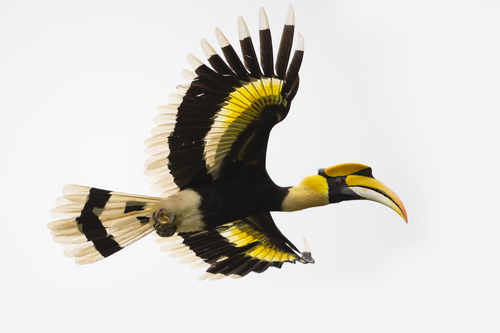
Females are smaller than males, and have bluish-white eyes instead of red eyes, though their orbital skin is pinkish. Like other hornbills, great hornbills have prominent "eyelashes". The species' most prominent feature is the bright yellow and black casque on top of its massive bill. When viewed from the front, the casque appears U-shaped; its top is concave, with two ridges along the sides that form points at the front. This shape gives the species its Latin epithet bicornis, which means two-horned. The back of the casque is reddish in females, while the underside of the front and back of the casque is black in males. The casque is hollow and has no confirmed known purpose, though researchers believe it is a product of sexual selection. Male great hornbills engage in aerial casque butting, where the birds strike each other in mid-flight. Males spread yellow preen gland secretion onto their primary feathers and bill to give these areas their bright yellow color. The beak commissure is black and has a serrated edge that wears down as the bird ages.
Great hornbill wing beats are heavy, and the sound birds produce in flight can be heard from far away. This sound has been compared to the puffing of a steam locomotive starting up. Their flight consists of stiff flaps followed by glides, with their flight feathers splayed and upcurled. Like other members of the hornbill family, great hornbills have highly pneumatized bones, with hollow air cavities that extend all the way to the tips of the wing bones. This anatomical feature was first noted by Richard Owen, who dissected a great hornbill specimen that died at the Zoological Society of London in 1833.
Great hornbills are native to the forests of India, Bhutan, Nepal, Mainland Southeast Asia, and Sumatra. Their distribution is fragmented in the Western Ghats and the foothills of the Himalayas. Deforestation has reduced the species' range across many parts of India, such as the Kolli hills, where it was first recorded in the 1860s. Great hornbills prefer dense, old-growth, unlogged forests in hilly regions, and appear to depend on large stretches of rainforest. In Thailand, male great hornbills were found to have a home range of about 3.7 km (2.3 mi) during the breeding season, and about 14.7 km (9.1 mi) during the non-breeding season. Molecular studies have been attempted to examine the species' population diversity.
Great hornbills are usually seen in small parties, though larger groups will sometimes gather at fruit trees. A congregation of 150 to 200 birds has been recorded in southeastern Bhutan. In the wild, the great hornbill's diet is mostly made up of fruit. Figs are a particularly important food source, and Vitex altissima is also noted as another key food source. Great hornbills also forage for lipid-rich fruits from the plant families Lauraceae and Myristicaceae, including species from the genera Persea, Alseodaphne and Myristica. Great hornbills get all the water they need from the fruit they eat, and are important seed dispersers for many forest tree species. They also eat small mammals, birds, small reptiles and insects. Lion-tailed macaques have been observed foraging alongside great hornbills. Great hornbills forage along branches, moving by hopping, as they search for insects, nestling birds and small lizards, tearing up bark to inspect it for prey. Prey is caught, tossed in the air, then swallowed. Rare prey items include the Travancore flying squirrel (Petinomys fuscocapillus); recorded bird prey in the Western Ghats include the Indian scops owl (Otus bakkamoena), jungle owlet (Glaucidium radiatum), and Sri Lanka green pigeon (Treron pompadora).
A great hornbill named William was the model for the logo of the Bombay Natural History Society, and also gave its name to the society's building. Norman Kinnear described William in the obituary of Walter Samuel Millard: Every visitor to the Society's room in Apollo Street will remember the Great Indian Hornbill, better known as the "office canary" which lived in a cage behind Millard's chair in Phipson & Co.'s office for 26 years and died in 1920. It is said its death was caused by swallowing a piece of wire, but in the past "William" had swallowed a lighted cigar without ill effects and I for my part think that the loss of his old friend was the principal cause.