About Bucco macrodactylus (von Spix, 1824)
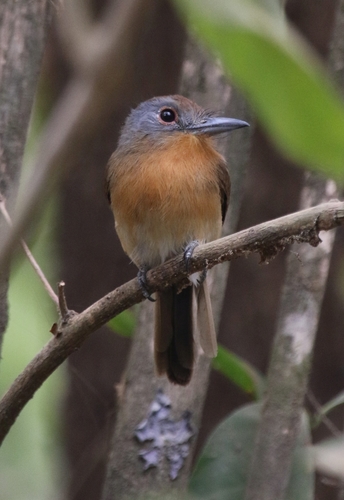
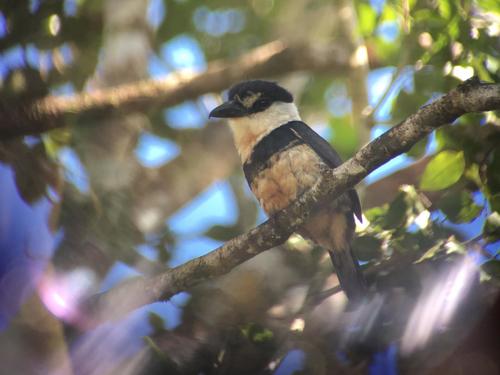
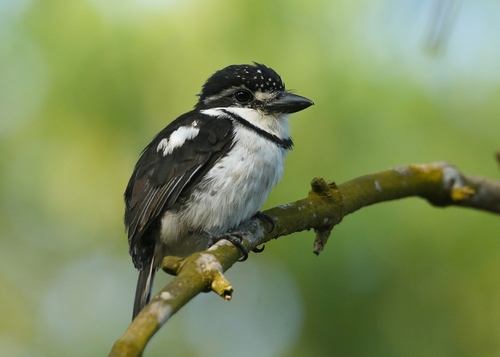
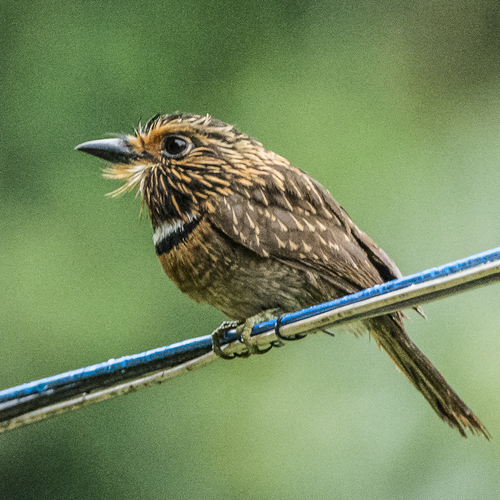
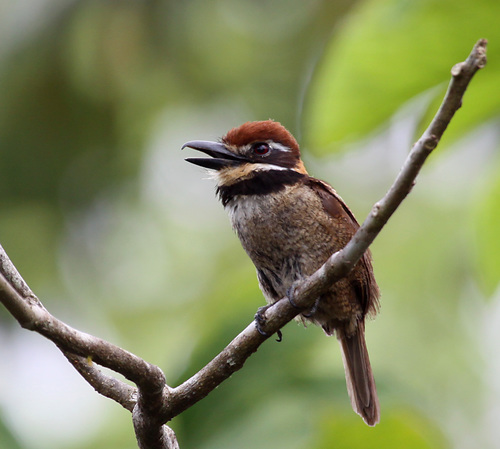
The chestnut-capped puffbird, scientifically named Bucco macrodactylus (von Spix, 1824), measures 14 to 16.5 cm (5.5 to 6.5 in) in length and weighs approximately 25 g (0.88 oz). Its plumage is unique among puffbirds. It has a chestnut crown and a bright reddish orange nape; the rest of its upperparts are brown, with a small number of lighter bars on the back and many lighter bars on the rump. Its tail is long, narrow, and warm dark brown. The species has a thin white supercilium, black cheeks and lower throat, a white line separating the cheeks and lower throat, and reddish white chin and upper throat. The chin feathers curl upward over the base of the bill. Below the black throat is a white band; the rest of the underparts are buffy with fine dusky barring, which does not extend to the lower belly. The bill is black, the eye ranges from red to brown, and the feet are brownish- to greenish gray. The chestnut-capped puffbird is distributed across the upper Amazon Basin, occurring in southern Venezuela, eastern Colombia, eastern Ecuador, eastern Peru, northern Bolivia, and western Brazil. It inhabits a wide range of forest types and is most typically found near water; common habitats include terra firme forest, várzea forest, early successional forest, secondary forest, and gallery forest. It can also live in scrubby forest away from water. It generally stays at relatively low heights, ranging from the undergrowth and understory up to the subcanopy, and often perches within 6 m (20 ft) of the ground. It is usually found at elevations below 660 m (2,200 ft), but has been recorded as high as 1,000 m (3,300 ft) in Peru, and once at 1,200 m (3,900 ft) in Ecuador.