About Bubo bubo (Linnaeus, 1758)
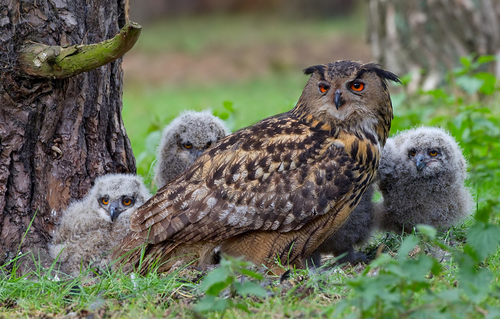
The Eurasian eagle-owl (Bubo bubo) is a large bird of prey. It is smaller than the golden eagle (Aquila chrysaetos) but larger than the snowy owl (Bubo scandiacus), though there is some overlap in size with both species. It is sometimes called the world's largest owl, but Blakiston's fish owl (B. blakistoni) has a slightly higher average weight, and the much lighter great grey owl (Strix nebulosa) is slightly longer on average. Heimo Mikkola reported that the largest Eurasian eagle-owl specimens reach the same maximum body mass of 4.6 kg (10 lb) as the largest Blakiston's fish owls, and grow around 3 cm (1.2 in) longer. On average, Blakiston's fish owl is slightly larger than the Eurasian eagle-owl in weight and wing size, even exceeding the largest Russian Eurasian eagle-owl subspecies in these measurements. Even though the Eurasian eagle-owl is 9 cm (3.5 in) shorter than the largest great grey owls, it can weigh well over twice as much as the largest great grey owls. The Eurasian eagle-owl typically has a wingspan of 131–188 cm (4 ft 4 in – 6 ft 2 in), and the largest individuals may reach a wingspan of 2 m (6 ft 7 in). Total body length ranges from 56 to 75 cm (22 to 30 in). Females weigh 1.75 to 4.6 kg (3.9 to 10.1 lb), while males weigh 1.2 to 3.2 kg (2.6 to 7.1 lb). For comparison, the globally widespread barn owl (Tyto alba) weighs about 0.5 kg (1.1 lb), and the great horned owl (B. virginianus), which fills the Eurasian eagle-owl's ecological niche in North America, weighs around 1.4 kg (3.1 lb). Apart from females being larger, there is little external sexual dimorphism in Eurasian eagle-owls, though male ear tufts are reportedly more upright than females'. When seeing a single eagle-owl in the field, it is generally impossible to tell its sex; sex can only be determined via in-hand size measurements. In some populations, females are typically slightly darker than males. Plumage coloration is highly variable across at least 13 recognized subspecies. Upper parts can range from brown-black to tawny-buff to pale creamy gray, usually with dense freckling on the forehead and crown, stripes on the nape, neck sides and back of the neck, and dark splotches on the pale base color of the back, mantle and scapulars. A narrow buff band, freckled with brown or buff, often runs from the base of the bill, above the inner part of the eye, and along the inner edge of the black-brown ear tufts. The rump and upper tail-coverts have delicate patterns of dark vermiculations and fine wavy barring, the extent of which varies by subspecies. The underwing coverts and undertail coverts have similar patterning, but tend to be more strongly barred in brownish-black. The primaries and secondaries are brown, with broad dark brown bars, dark brown tips, and irregular grey or buff lines. Eurasian eagle-owls undergo a complete annual moult between July and December. The facial disc is tawny-buff, speckled with black-brown that is dense enough on the outer edge of the disc to form a 'frame' around the face. The chin and throat are white, with a brownish central streak. Upper breast feathers generally have brownish-black centers and reddish-brown edges, except for the central feathers which have white edges. The white of the chin and throat often extends down the center of the upper breast. Lower breast and belly feathers range from creamy-brown to tawny buff to off-white, with a variable amount of fine dark wavy barring over a tawny-buff base color. The legs and feet, which are feathered almost to the talons, have faint similar markings on a buff base. The tail is tawny-buff, mottled dark grey-brown with around six black-brown bars. The bill and feet are black. The iris is most often orange, but is quite variable: some European birds have a bright reddish blood-orange iris, while subspecies from arid desert-like habitats can have orange-yellow irises. Most closely related species generally have yellowish irises, with the exception of the Indian eagle-owl. Eurasian eagle-owls have a sparse distribution, but can inhabit a wide range of habitats, and prefer landscapes with irregular topography. They have been found in habitats as varied as northern coniferous forests to the edges of large deserts. They live in nearly every climatic and environmental condition across the Eurasian continent, with the exception of extreme environments: they are absent from humid rainforests in Southeast Asia and the high Arctic tundra, where they are replaced by other Bubo owl species. They reach their highest population densities in areas where cliffs and ravines are surrounded by scattered trees and bushes. Grassland areas such as alpine meadows or desert-like steppe can also host them, as long as rocky areas provide cover and protection. Most studies confirm the species' preference for irregular topography. A clear benefit of this habitat for nesting and daytime roosts is that rocky areas and steep slopes are less accessible to predators, including humans. They may also be drawn to areas near riparian zones or wetlands, because wet soft soil supports burrowing by the small terrestrial mammals that are their preferred prey, such as voles and rabbits. Due to their preference for rocky areas, the species is often found in mountainous regions: it occurs up to 2,100 m (6,900 ft) in the Alps, 4,500 m (14,800 ft) in the Himalayas, and 4,700 m (15,400 ft) on the adjacent Tibetan Plateau. They also live at sea level, and may nest on rocky sea cliffs. Although they thrive in cold subarctic zones and mountain areas that are frigid most of the year, studies from Germany's Eifel region found that warmer conditions lead to more successful breeding attempts. A study in Spain found that eagle-owls preferred mostly forested study areas (52% forest cover), with pines preferred over oaks, compared to fully mixed pine-oak woodland. Pine and other coniferous stands are also preferred by great horned owls, because their constant canopy makes large owls harder to spot. In mountainous forests, they do not usually live in closed-in wooded areas like tawny owls (Strix aluco), and instead stay near forest edges. In the Spanish habitat study, cultivated or agricultural land made up only 2.7% of the territory within eagle-owl home ranges. Compared to golden eagles, however, eagle-owls can visit cultivated land more regularly when hunting, because their nocturnal habits let them largely avoid human activity. Other sources note that eagle-owls only visit farmland that is not intensively farmed, has extensive tree and bush cover, and little to no irrigation; farmland with fallow or abandoned fields has more prey and less frequent human disturbance, so it is more likely to be visited. In the Italian Alps, where almost no pristine habitat remains, eagle-owls locally nest near towns, villages, and ski resorts. While they are most numerous in areas sparsely populated by humans, they sometimes live on farmland, and have even been observed living in park-like or quiet settings within European cities. Since 2005, at least five pairs have nested in Helsinki, partly because feral European rabbits (Oryctolagus cuniculus) from released pet rabbits have recently become established in the area. The population of eagle-owls in Helsinki is expected to grow as the European rabbit population increases. European hares (Lepus europaeus), the prey preferred by biomass for eagle-owls in their natural habitat, only live in rural Finland, not in the city centre. In June 2007, an eagle-owl nicknamed 'Bubi' landed in the crowded Helsinki Olympic Stadium during the European Football Championship qualification match between Finland and Belgium, interrupting the match for six minutes. After the opening goal for Finland by Jonathan Johansson, the bird left the area. Finland's national football team has had the nickname Huuhkajat, Finnish for Eurasian eagle-owls, ever since. The owl was named 'Helsinki Citizen of the Year' in December 2007. In 2020, a female Eurasian eagle-owl raised a brood of three chicks in a large, leafy planter on an apartment window in the city centre of Geel, Belgium. The Eurasian eagle-owl has one of the widest distributions of any owl species, though its range is far smaller than that of the short-eared owl (Asio flammeus) and long-eared owl, and lacks the circumpolar range of boreal species such as the great grey owl, boreal owl, and northern hawk owl (Surnia ulula). The westernmost part of the species' range is the Iberian Peninsula, where it occurs across nearly all of Spain and more sparsely in Portugal. From there, it ranges widely across southern France from Toulouse to Monaco, and reaches as far north as central France's Allier department. Further north, it occurs sporadically and discontinuously in Luxembourg, southern and western Belgium, and rarely reaches the Netherlands. It is found infrequently in southern and central United Kingdom. In Germany, the eagle-owl occurs in large but highly discontinuous areas, mostly in southern and central Germany, and is almost entirely absent from areas such as Brandenburg. South of Germany, the species' range is nearly continuous into the Czech Republic, Slovakia, northern and eastern Hungary, and very sparsely into Poland. The eagle-owl is found quite broadly across the fairly mountainous countries of Switzerland and Austria. In Italy, it occurs in suitable habitat across much of the northern, western, and central parts of the country, as far south as Melito di Porto Salvo. From Italy, the species ranges widely along the Mediterranean coast of Southeastern Europe, from Slovenia continuously through most of Greece and Bulgaria. In eastern Europe, the Eurasian eagle-owl occurs across nearly the entire region from central Romania to Estonia. It also occupies most of Finland and Scandinavia: it is widespread in Norway, somewhat more sparsely distributed in Sweden, and widespread in Jutland, Denmark (absent from Danish islands). The Eurasian eagle-owl's range in Russia is very large, and the species is nearly unrestricted by habitat there, only absent from the true Arctic zone, with its range ending around the tree line. Even if it is not the most densely distributed owl species in Russia, it is almost certainly the most widely distributed. From Russia, it occurs throughout Central Asia, continuously across every country from Kazakhstan down to Afghanistan. In Asia Minor, it is widespread in Georgia, Azerbaijan, and occurs somewhat widely in western and southern Turkey, but is overall quite sparsely distributed across Turkey. It also has a spotty range in the Middle East across Syria, Iraq, Lebanon, Israel, Palestine, Jordan, and western Iran, and is only widespread in northern and western Iran. In South Asia, it occurs most often in northern Pakistan, northern Nepal, and Bhutan, and occurs marginally in far northern India. It lives across all of Mongolia, and nearly all of China (it is mainly absent only from southern Yunnan and southern Guangxi). From China and eastern Russia, it occurs throughout Korea, Sakhalin, the Kuril Islands, and rarely reaches Japan's northern Hokkaido. Aside from the Kuril Islands, the easternmost point of the species' range is Magadan in the Russian Far East.