About Bubalus bubalis (Linnaeus, 1758)
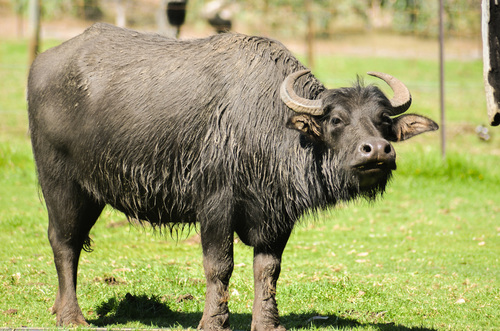
Bubalus bubalis includes two main types: river buffalo and swamp buffalo, with distinct physical and genetic characteristics. River buffalo typically have black skin, though some individuals have dark slate-colored skin; they have longer faces, smaller girths, larger limbs than swamp buffalo, and their dorsal ridges extend further back and taper more gradually. Their horns grow downward and backward before curving upward in a spiral. Swamp buffalo are born with grey skin that turns slate blue as they mature, and albinoid individuals occur in some populations. They are heavy-bodied and stockily built, with a short body, large belly, flat forehead, prominent eyes, short face, wide muzzle, comparatively long neck, and prominent withers and croup. Their dorsal ridge extends backward and ends abruptly just before the end of the chest. Their horns grow outward, curve in a semicircle, and generally stay level with the plane of the forehead. Their tails are short, reaching only to the hocks. Body size and horn shape vary widely between breeds. Withers height ranges from 129–133 cm (51–52 in) for bulls and 120–127 cm (47–50 in) for cows, though large individuals can reach 160 cm (63 in). Mature total head-to-rump length is typically 240–300 cm (94–118 in), with a tail length of 60–100 cm (24–39 in). Body weight ranges from 300–550 kg (660–1,210 lb), and individuals weighing over 1,000 kg (2,200 lb) have been recorded. A specific Sulawesi variant called Tedong bonga is a piebald water buffalo with unique black-and-white coloration favored by the Toraja people. Genetically, swamp buffalo have 48 chromosomes, while river buffalo have 50 chromosomes. The two types do not interbreed readily, but fertile offspring can be produced. No naturally occurring water buffalo-cattle hybrids have been observed, though hybrid embryos mature in laboratory experiments at lower rates than non-hybrid embryos. The rumen of water buffalo differs from that of other ruminants: it holds a larger population of bacteria, especially cellulolytic bacteria, lower protozoa counts, and higher numbers of fungal zoospores. It also has higher levels of rumen ammonia nitrogen (NH4-N) and higher pH than the rumen of cattle. In terms of ecology and behavior, river buffalo prefer deep water, while swamp buffalo prefer to wallow in mudholes they create with their horns. Wallowing leaves a thick coating of mud on their skin. Both types are well adapted to hot, humid climates where winter temperatures can drop to 0 °C (32 °F) and summer temperatures can reach or exceed 30 °C (86 °F). Access to water for wallowing, rivers, or splashing is critical for thermoregulation in hot conditions. Some water buffalo breeds are adapted to saline seaside shores and saline sandy terrain. For reproduction, swamp buffalo generally reach reproductive maturity at an older age than river buffalo breeds. Young males in Egypt, India, and Pakistan are first mated around 3.0–3.5 years of age, while males in Italy may be used for mating as early as 2 years of age. Successful mating can continue until the animal is 12 years old or even older. A healthy mature river buffalo male can impregnate 100 females in a single year. Mating is strongly influenced by season, and heat stress reduces male libido. While water buffalo are polyoestrous, their reproductive efficiency varies widely across the year. Cows show clear seasonal changes in the frequency of oestrus, conception rate, and calving rate. The age of first oestrus in heifers ranges from 13 to 33 months across breeds, but mating at first oestrus is usually infertile, so mating is typically deferred until heifers are 3 years old. Gestation lasts between 281 and 334 days, with most recorded ranges falling between 300 and 320 days. Swamp buffalo gestation is one to two weeks longer than river buffalo gestation. It is not uncommon for water buffalo to continue working well up to age 30, and there are recorded cases of water buffalo with a 40-year working lifespan.