About Bubalornis niger A.Smith, 1836
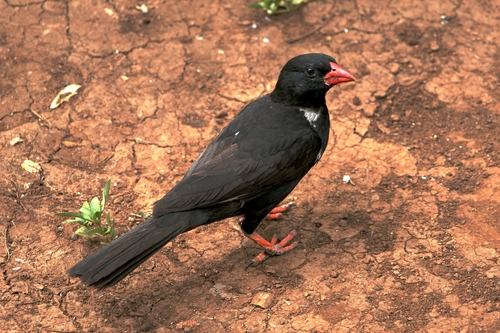
Full-grown red-billed buffalo weavers (scientific name Bubalornis niger A.Smith, 1836) have a body length of 21 to 25 cm (8.3 to 9.8 in). Average body mass is 82.1 g (2.90 oz) for males and 70.7 g (2.49 oz) for females. This species may be the largest in the Ploceidae (weaver bird) family. Visually, males and females do not differ greatly from one another. This species can be told apart from the closely related white-billed buffalo weaver (Bubalornis albirostris) by the color of its bill. Males have dark chocolate brown feathers, with white flecks on the front wing edges and wing tips, a red-colored bill, brown eyes, and reddish brown feet. Females also have dark chocolate brown body plumage, but lack the white flecks on the wings; instead, their chin and throat feathers have broad white edges. Females have dark brown eyes and light brown legs. Juvenile birds have a lighter shade of brown plumage than adults. Red-billed buffalo weavers breed in colonies. Their nests are large masses made from thorny twigs, which are split into separate compartments called lodges. Each lodge contains multiple egg chambers, and each chamber holds a smaller nest that is typically built by the female, unless the colony is a cooperative breeding colony. This smaller inner nest is made from grass, leaves, and roots. The complete large nest is usually located in a thorny tree, or on a windmill near areas where humans live. When humans abandon an area, the red-billed buffalo weavers that lived there will also leave. White-backed vultures and bateleurs often build their own nests on top of red-billed buffalo weaver nests, which helps camouflage the vultures' and bateleurs' nests from predators. Male red-billed buffalo weavers have a pseudo-penis that is around 1.5 cm long. This structure was first reported in an 1831 report by a German anatomist studying these birds. Later research shows the trait is selected for by females. The pseudo-penis has no blood vessels and does not transport sperm, but females appear to favor it for pleasure, and it helps males attract mates. Males that live in colonies have larger pseudo-penises than solitary males, which suggests male-male competition has also favored the growth of this unusual structure. The egg-laying season for this species can last from September to June, with peak laying occurring between December and March. Females lay between 2 and 4 eggs per clutch, and incubate the eggs for around 14 days. Only females care for the eggs during incubation. The young birds leave the nest 20 to 23 days after hatching.