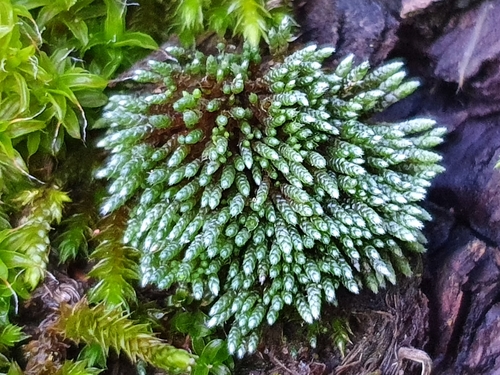
About Bryum argenteum Hedw.
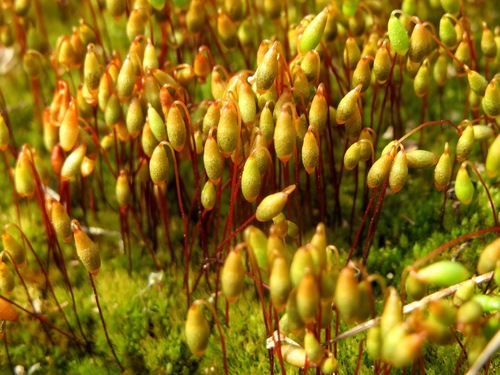
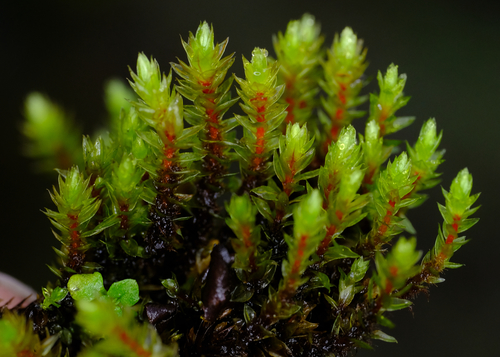
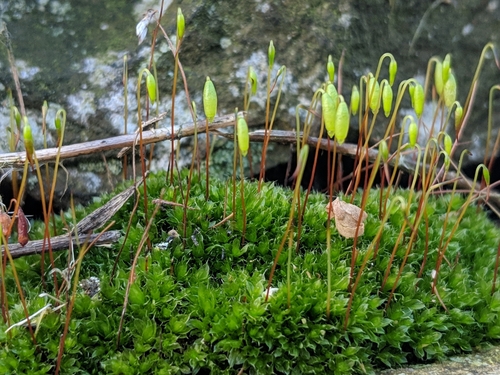
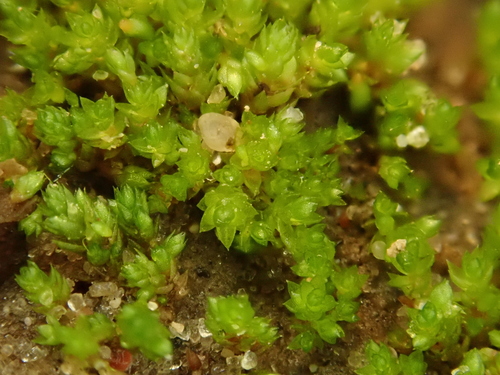
When dry, Bryum argenteum Hedw. is silvery-green or whitish-green. This coloration comes from the broadly ovate individual leaflets, which do not produce chlorophyll at their tips. The leaf costa extends past the middle of the leaf. In damp, undisturbed sites, branches may develop a more horizontal growth habit. The upper cells on the leaf surface are elongated rhomboid in shape. The sporophyte capsule is short cylindrical, broader at the base, and colored dark red to black. This species has a high tolerance for drought and pollution in urban environments. It is classified as a desiccation-tolerant species that can survive complete drying. While desiccation tolerance is a common trait among mosses, B. argenteum was one of the first bryophytes experimentally confirmed to have this ability. It is an adaptable species with a cosmopolitan distribution, occurring in Europe, North America, the deserts of Australia, and Antarctica. It grows well in areas with high human activity, including on rocks, paving stone gaps, asphalt, and roadsides. It grows especially well in inner cities and industrial areas. As a nitrogen-loving species, it also grows on nitrophilic soils in urban areas. It can be found growing in lawns and alongside other moss communities. This species is most often spread by vegetative fragments that cling to people’s shoes, and the feet or hooves of animals. It also spreads through the production and sale of plant liners. Liners that carry B. argenteum, often in association with Marchantia polymorpha, are commonly grown in one region, transported to another region for further growth, and then shipped to a retail location before planting. B. argenteum can be picked up or dispersed at every stage of this transfer process.